Sunday, January 30, 2022

BBC on language

 Adjectives in English absolutely have to be in this order: opinion-size-age-shape-colour-origin-material-purpose Noun. So you can have a lovely little old rectangular green French silver whittling knife. But if you mess with that word order in the slightest you’ll sound like a maniac. It’s an odd thing that every English speaker uses that list, but almost none of us could write it out.”

Actually, there are a couple of small exceptions. Little Red Riding Hood may be perfectly ordered, but the Big Bad Wolf seems to be breaking all the laws of linguistics. Why does Bad Big Wolf sound so very, very wrong? What happened to the rules?

Well, in fact, the Big Bad Wolf is just obeying another great linguistic law that every native English speaker knows, but doesn’t know that they know. And it’s the same reason that you’ve never listened to hop-hip music.

You are utterly familiar with the rule of ablaut reduplication. You’ve been using it all your life. It’s just that you’ve never heard of it. But if somebody said the words zag-zig, or ‘cross-criss you would know, deep down in your loins, that they were breaking a sacred rule of language. You just wouldn’t know which one.


All four of a horse’s feet make exactly the same sound. But we always, always say clip-clop, never clop-clip. Every second your watch (or the grandfather clock in the hall makes the same sound) but we say tick-tock, never tock-tick. You will never eat a Kat Kit bar. The bells in Frère Jaques will forever chime ‘ding dang dong’.


Reduplication in linguistics is when you repeat a word, sometimes with an altered consonant (lovey-dovey, fuddy-duddy, nitty-gritty), and sometimes with an altered vowel: bish-bash-bosh, ding-dang-dong. If there are three words then the order has to go I, A, O. If there are two words then the first is I and the second is either A or O. Mish-mash, chit-chat, dilly-dally, shilly-shally, tip top, hip-hop, flip-flop, tic tac, sing song, ding dong, King Kong, ping pong.


The language rules we know – but don’t know we know
Share on Linkedin
(Credit: Matthew Anderson)
Mark Forsyth tasted internet fame this week when a passage from a book he wrote went viral. He explains more language secrets that native speakers know without knowing.

Article continues below

O

Over the weekend, I happened to go viral. Or rather a single paragraph from a book I wrote called The Elements of Eloquence went viral. The guilty paragraph went like this:

“Adjectives in English absolutely have to be in this order: opinion-size-age-shape-colour-origin-material-purpose Noun. So you can have a lovely little old rectangular green French silver whittling knife. But if you mess with that word order in the slightest you’ll sound like a maniac. It’s an odd thing that every English speaker uses that list, but almost none of us could write it out.”
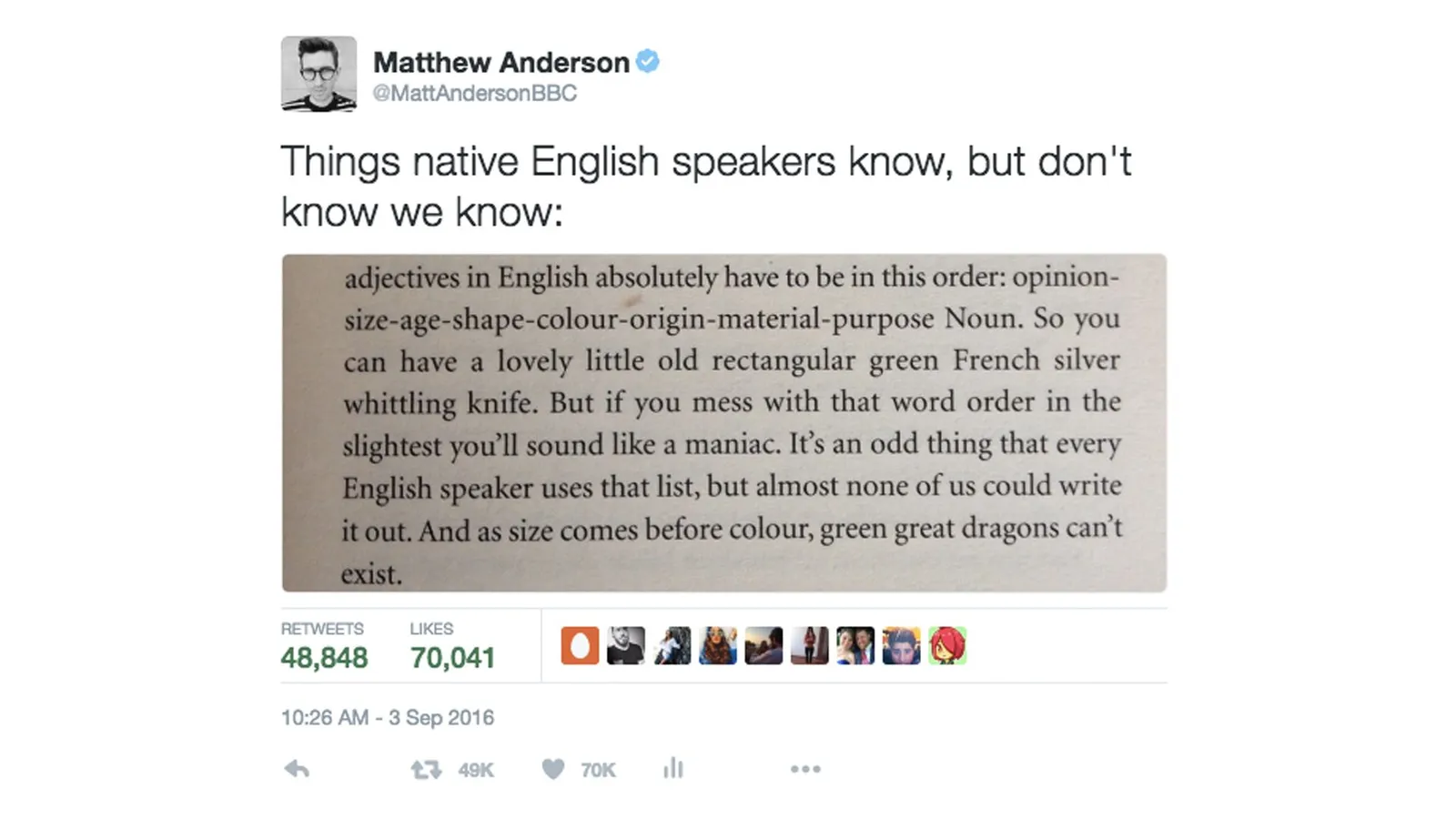
BBC Culture’s editor Matthew Anderson tweeted a passage from Mark Forsyth’s The Elements of Eloquence and it went viral (Credit: Matthew Anderson)

BBC Culture’s editor Matthew Anderson tweeted a passage from Mark Forsyth’s The Elements of Eloquence and it went viral (Credit: Matthew Anderson)

English speakers love to learn this sort of thing for two reasons. First, it astonishes us that there are rules that we didn’t know that we knew. That’s rather peculiar, and rather exciting. We’re all quite a lot cleverer than we think we are. And there’s the shock of realising that there’s a reason there may be little green men on Mars, but there certainly aren’t green little men. Second, you can spend the next hour of your life trying to think of exceptions, which is useful as it keeps you from doing something foolish like working.

ADVERTISEMENT

Actually, there are a couple of small exceptions. Little Red Riding Hood may be perfectly ordered, but the Big Bad Wolf seems to be breaking all the laws of linguistics. Why does Bad Big Wolf sound so very, very wrong? What happened to the rules?

Ding dong King Kong

Well, in fact, the Big Bad Wolf is just obeying another great linguistic law that every native English speaker knows, but doesn’t know that they know. And it’s the same reason that you’ve never listened to hop-hip music.

If somebody said ‘zag-zig’ or ‘cross-criss’ you would know they were breaking a rule

You are utterly familiar with the rule of ablaut reduplication. You’ve been using it all your life. It’s just that you’ve never heard of it. But if somebody said the words zag-zig, or ‘cross-criss you would know, deep down in your loins, that they were breaking a sacred rule of language. You just wouldn’t know which one.

All four of a horse’s feet make exactly the same sound. But we always, always say clip-clop, never clop-clip. Every second your watch (or the grandfather clock in the hall makes the same sound) but we say tick-tock, never tock-tick. You will never eat a Kat Kit bar. The bells in Frère Jaques will forever chime ‘ding dang dong’.

Reduplication in linguistics is when you repeat a word, sometimes with an altered consonant (lovey-dovey, fuddy-duddy, nitty-gritty), and sometimes with an altered vowel: bish-bash-bosh, ding-dang-dong. If there are three words then the order has to go I, A, O. If there are two words then the first is I and the second is either A or O. Mish-mash, chit-chat, dilly-dally, shilly-shally, tip top, hip-hop, flip-flop, tic tac, sing song, ding dong, King Kong, ping pong.

“What about the Big Bad Wolf?” tweeted many naysayers. But they obviously didn’t know about the rule of ablaut reduplication (Credit: Alamy)

“What about the Big Bad Wolf?” tweeted many naysayers. But they obviously didn’t know about the rule of ablaut reduplication (Credit: Alamy)

Why this should be is a subject of endless debate among linguists, it might be to do with the movement of your tongue or an ancient language of the Caucasus. It doesn’t matter. It’s the law, and, as with the adjectives, you knew it even if you didn’t know you knew it. And the law is so important that you just can’t have a Bad Big Wolf.

Tense situations

It’s astonishing quite how expert you are at the English language. There are so many tenses you can use without even thinking about it, and almost certainly without being able to name them. It depends how you count them, but there are about 20 that you deploy faultlessly. The pluperfect progressive passive for an extended state of action that happened to you prior to another action in the past is, when you put it like that, rather daunting. But then you’d happily say “I realised I’d been being watched” without breaking sweat or blinking. Think how daunting this is for people learning English. The teacher has to explain to them that the English don’t usually use the present tense for things that are happening in the present. “I brush my teeth” doesn’t mean that you’re doing it right now, it just means that you do it regularly. For things that are actually happening right now you use the present progressive “I’m brushing my teeth”.

And having learnt that you then have to learn that there are certain exceptions, like the verb ‘to think’ used as an auxiliary, as in “I think you’re right”. This is why, incidentally, lots of non-native speakers will use phrases like “I am thinking that you are right”. It sounds faintly comic to us, but we had years and years and years of immersion learning just to get all these subtleties. And English is complex and weird. We actually have a tense called the Future Present. Imagine having to learn that. But for us it’s just “The train leaves tomorrow.”


Some rules we really should know. It’s surprising and dispiriting how many English people don’t know the rules of stress, because that’s how all our poetry works. It’s quite easy really, and we can hear it in other languages. Everyone knows that Italian has rhythm, it goes MAM-a MI-a BUON-a SER-a. But so does our language. And that’s how verse works. I can illustrate with my favourite limerick (or at least my favourite clean one). Try reading this aloud:


There was a young man from Dundee

Got stung on the leg by a wasp

When asked does it hurt

He said ‘Yes it does.

‘I’m so glad it wasn’t a hornet.’


That has no rhymes, but it still works as a limerick because rhymes aren’t nearly as important as rhythm. And the rhythm goes:


de-DUM-de, de-DUM-de, de-DUM

de-DUM-de, de-DUM-de, de-DUM

de-DUM-de, de-DUM

de-DUM-de, de-DUM

de-DUM-de, de-DUM-de, de-DUM-de


Saturday, January 22, 2022

The last of God

 By R Wright

Back into Time 


That religious ideas naturally appeal to the human mind doesn’t, by itself, explain how religion got off the ground. Granted that religious “memes” have a “selective advantage” in cultural evolution, how exactly would a given meme—a particular religious belief — first take shape and gain momentum? We’ll never know for sure, but human nature makes it easy to sketch a plausible scenario. 


First, people like to command attention, and one way to do that is to place yourself at the center of dramatic events. In Mark Twain’s The Adventures of Tom Sawyer, Tom Sawyer runs away with his friends Huckleberry Finn and Joe to play pirates on the Mississippi River, and the townspeople conclude that the boys have drowned. Twain describes their friends gathering and talking in reverent tones of how Tom did so-and-so, the last time they saw him, and how Joe said this and that small trifle (pregnant with awful prophecy, as they could easily see now!) —and each speaker pointed out the exact spot where the lost lads Stood at the time, and then added something like ‘“‘and I was astanding just so—just as I am now, and as if you was him—I was as close as that—and he smiled, just this way—and then something seemed to go all over me, like—awful, you know —and I never thought what it meant, of course, but I can see now!” 


Then there was a dispute about who saw the dead boys last in life, and many claimed that dismal distinction, and offered evidences, more or less tampered with by the witness; and when it was ultimately decided who did see the departed last, and exchanged the last words with them, the lucky parties took upon themselves a sort of sacred importance, and were gaped at and envied by all the rest.?? 


There is no reason to think that this incentive to claim special witness to high drama was any less powerful among hunter-gatherers circa 30,000 BCE than among midwestern Americans circa 1900 CE. Imagine that you are one of those hunter-gatherers and you walk past a place where someone died mysteriously, and you hear leaves rustle eerily. That’s a story that will get people’s attention, and you can heighten the attention by stressing how exquisitely timed the rustling was. And, by the way, didn’t you catch sight of a shadowy — almost ethereal —creature out of the corner of your eye? 


The anthropologist Stewart Guthrie has suggested that huntergatherers would be encouraged to make just such false sightings by standard human mental equipment — something called a “hyperactive agent-detection device.” Because the costs of failing to detect a predator lurking in the woods are much higher than the costs of detecting one that isn’t there, natural selection, he plausibly argues, may have biased our brains toward “false positives”: you hear a rustling, your mind flashes the vivid hypothesis of some generic animal that’s doing the rustling, and you turn toward it expectantly. Did you actually see something? Kind of. 


In any event, if upon recounting your eerie encounter you get caught up in the spirit of the story and say you saw an ethereal being, then you may convince not just your audience, but yourself. One notable finding of modern psychology is how systematically misleading memory is. People often remember events wrongly from the get-go, and even when they don’t, their memory can later be steered toward falsehood. In particular, the act of reporting false details can cement them firmly in mind. You don’t just recount what you remember, you remember what you recount.”4 (Football star O. J. Simpson’s former agent was sure Simpson had killed his ex-wife and also sure that Simpson believed he didn’t.)*5 This built-in fallibility makes sense from a Darwinian standpoint, allowing people to bend the truth self-servingly with an air of great and growing conviction, And, clearly, bent truths of a religious sort could be self-serving. If you were a Close friend or relative of the deceased, then the idea that his powerful spirit is afoot may incline people to treat you nicely, lest they invite his wrath. 


Another gem from social psychology: publicly espousing something not only helps convince you of its truth; it shapes your future perception, inclining you to see evidence supporting it but not evidence against it.7° So if you speculate that the strange, shadowy creature was the disgruntled spirit of the deceased, you’! likely find corroboration. You may notice that one of his enemies fell ill only a week after your sighting, while forgetting that one of his friends fell ill a few days earlier. 


If you’re a person of high status, all of this will carry particular weight, as such people are accorded unusual (and often undue) credibility. If, in a hunter-gatherer band of thirty people, someone widely esteemed claims to have seen something strange — and has a theory about what it was—twenty people may be convinced right off the bat. Then the aforementioned tendency of people to conform to peer opinion could quickly yield unanimity.’ 


The number of mental tendencies involved in the creation and nourishment of religious falsehoods shouldn’t surprise us. After all, the mind was built by a process that is, strictly speaking, indifferent to truth. Natural selection favors traits that are good at getting their bearer’s genes into the next generation, period. If saying something false, or believing something false, often furthered that goal dur ing human evolution, then the human mind will naturally encoulage some kinds of falsity. This systematic muddle isn’t an exclusive property of the “primitive” mind, as John Lubbock (chapter I) suggested: all of the above delusory tendencies have been documented in people living in modern societiesmany of them students at fine universities! 


So why are people in modern societies so often aghast at “primirive” religion, so unable to comprehend how “primitive” belief got started? In part, it is the classic human failure of objectivity —an inability to see that your own beliefs may seem as strange to others as theirs seem to you. (An African Pygmy once responded to a missionary’s description of heaven by asking, ““How do you know? Have you died and been there?’’) And in part it is a failure of imagination. Imagine that you are living in a smal] encampment surrounded by jungle or woodland or desert, entirely untouched by science and modern technology. Within the encampment, the social universe operates by largely intelligible laws; people don’t generally, say, fly into a rage and assault their neighbors without a cause of some sort or another. But from outside this universe come mighty and momentous forces—storms, droughts, deadly animals, fatal illness. You are viscerally interested in explaining and controlling these things; you readily absorb and repeat any news or conjecture bearing on this goal. And, above all, you are only human. The rest is history. 


Thinking and Feeling 


This view of religion’s origins—the view from modern psychology—is in some ways just an updated version of Edward Tylor’s view: people first conceived of gods and spirits to explain the unexplained. Indeed, Tylor even seemed to vaguely anticipate the modern focus on reciprocal altruism: “Spiritual beings are held to affect or control the events of the material world, and man’s life here and hereafter; and it being considered that they hold intercourse with men, and receive pleasure or displeasure from human actions, the belief in their existence leads naturally, and it might almost be said inevitably, sooner or later to active reverence and propitiation.”?* 


Still, there is a difference of emphasis. When Tylor says belief in gods “leads naturally” to their propitiation, he seems to mean that this progression was logically natural—that extended reflection led eventually to the conclusion that giving gods respect and foodstuffs would satisfy them. An evolutionary psychologist, 1n contrast, might stress how viscerally natural this propitiation 1s; it feels like the right thing to do. Tylor’s oft-ridiculed reference to “ancient savage philosophers” (see chapter 1) does indeed connote more in the way of cool, detached reflection than was probably operative — and than is operative generally in human beings. Some features of the mind that undergird religious belief are “cognitive” traits that guide our “intellectual” lives but are also shot through with feeling. 


Saturday, January 15, 2022

Last batch of clippings

S. SCHAMA 

A constant refrain throughout this long literature of complaint, and what European intellectuals even now find most repugnant, is American sanctimoniousness, the habit of dressing the business of power in the garb of piety.

Other characteristics of American life alienated the Romantics: the distaste for tragedy (a moral corrective to illusions of invincibility); the strong preference for practicality; the severance from history; and, above all, what the Germans called Bodenlosigkeit, a willed rootlessness, embodied in the flimsy frame construction of American houses. Europeans watched, pop-eyed, while whole houses were moved down the street. This confirmed their view that Americans had no real loyalty to the local, and explained why they preferred utilitarian “yards” to flower gardens. No delphiniums, no civility. 


‘The British who arrived in the United States in the eighteen-thirtes and forties had imagined the young republic as a wide-eyed adolescent, socially ungainly and politically gauche, but with some hint of promise. What they found was a country experiencing an unprecedented growth spurt, both territorial and demographic, and characterized by an unnerving rudeness, in both senses of the word. Ladies and gendemen dodged quids of tobacco juice and averted their gaze from the brimming cuspidors thar greeted visitors to steamboat saloons and hotel and theatre lobbies. The hallmark of Jacksonian America seemed to be a beastly indifference to manners, the symptom of a society where considerateness to others was a poor second to the immediate satisfaction of personal wants. 


The conduct of Americans at dinner said it all. They wolfed down their food, cramming cor bread into their sloppy maws during meals that were devoured in silence, punctuated only by slurps, grunts, scraping knives, and hacking coughs. (All those cigars.) At the Plate House in the business district of New York, naval captain and travel writer Basil Hall was astonished by the speed at which the comed beef arrived and then by the even greater speed at which it was demolished: “We were not in the house above twenty minutes, but we sat out two sets of company at least.” Only the boy waiters yelling orders at the kitchen broke the quiet. The lack of polite conversation suggested the melancholy and dispiriting monotony of American life, on which almost all the early reporters commented. Tocqueville explained the apparent paradox of anxiety amid prosperity as the result of the relentless obligation to be forever Up and Doing. 


The European commentators’ dismay at the tyranny of American materialism was disingenuous, since many of them had come to the United States to repair their tattered fortunes or make new ones. Frances Trollope decided to sojourn in America when a rich uncle did the Trollopes the disservice of marrying late in life and, still worse, begetting an heir. Fanny Wright, whose ardor for America had been relit by the Marquis de Lafayette’s triumphal tour in 1824 and 1825, visited Mrs. Trollope at her expensive rented house at Harrow 

....who were barely subsisting. Of the all important school there wits no sight and no prospect. Mrs. Trollope, aghast at the filth and the fever-bearmg mosquitocs, fled with her childten to Cincinnati, which was, alas, an “uninteresting mass of buildings,” where hogs rooted in the streets. Together with the French painter Auguste Hervicu (who had intended to teach at Nashoba), she flung herself into show business, remodelling a “Western Museum,” . which had hitherto been a _ collection of natural curiosities and patriotic waxworks. Her son Henry became the Invisible Girl, booming prophecies  in creepy darkness, and, with the help of glass transparencies, she created a vision of the Infernal Regions, featuring frozen lakes with erupting fountains of flame, and electric shocks should the customers, peering through grates, try and touch the exhibits. Mrs. ‘Trollope’s next venture, a galleried, gaslit emporium of consumer wonders, stocked with fancy goods supplied from Harrow by her husband, ended in debt practically before it began. 

Hollywood movies.. for the illiterate, for poor creatures stupefied by work and anxiety,” were the Trojan horse for the Americanization of the world. Jean Baudrillard’s belief that the defining characteristic of America is its fabrication of reality was anticipated by Duhamel’s polemics against the “shadow world” of the movies, with their reduction of audiences to somnolent zombies sitting in the dark. 

&

A headline in the Times of July 22, 1948, read “GORKY 'S COUSIN ENDS LIFE.” According to the brief obituary that followed, a Russian born American painter, forty-five years old, had hanged himself in a barn on his property in Sherman, Connecticut. The story was full of errors. The painter, Arshile Gorky, was unrelated to the celebrated Communist writer Aleksey Peshkov, whose pen name was Maxim Gorky. He was probably forty-eight years old, and was born Vosdanig Adoian, in a village in Turkish Armenia. The Sherman property wasn't his—he was too poor to own much of anything and tne building that he selected to die in was a shed. The obit’s major errors repeated lies that Gorky regularly told about himself. He kept secret his memories of the massacres, famine, and epidemics that decimated his people during the First World War. He spoke passionately of his mother but rarely of her death in his presence, at the age of thirty-nine, perhaps of starvation. 

Herrera begins her book with a barbaric scene. In 1903, in an ancient monastery church near Lake Van, Turkey, “Arshile Gorky’s grandmother, the widow Hamaspiur, had brought the family together to hold a vigil for her youngest son, sixteen-year-old Nishan, who had vanished several days earlier. She suspected that he had been abducted by Kurds, for he had fallen in love with a Kurdish girl whose brother took offense. ... Only five years earlier, her husband, Sarkis Der Marderosian, the last of a long line of Armenian apostolic priests, had been nailed to the door of the church where he served in Van City.” As the family prayed, there was a thud at the door. Outside, they found Nishan’s blood-drenched body. Months of wild grief later, “to revenge herself against God,” Hamaspiur set the monastery church on fire. “Arshile Gorky would look back with admiration at his grandmother's rebellious spirit,” 

Rejecting his father’s expectation that he would be a factory worker, Gorky enrolled in Boston’s New School of Design in 1922 and dove into the study of art, partly in schools but mainly in museums. He was savagely proud. When a teacher disparaged his work, he destroyed the canvas that he was working on and walked out of the class for good. He took menial jobs and earned money for a time on the vaudeville stage, chalking likenesses of American Presidents, one a minute, on a blackboard. He later told of swimming out into the Charles River to drown himself and being driven back to shore by the sudden thought, “What about painting?” In 1925, he moved to New York, where he became a charismatic teacher (one of his students was Mark Rothko) anda dashing presence. In 1929, he moved into a space at 36 Union Square which he rented for the rest of his life. Herrera writes that Gorky would stride into the square in “a long black overcoat, a red scarf, and either a proletarian-looking wool knit cap or, on days when he wanted to look prosperous or gangsterish, a black felt hat tilted forward over his eyes.” He haunted museums. His favorite Old Masters were Uccello and Ingres, both of them radical engineers of style. One day at the Metropolitan, a woman reacting to his long hair and beard quipped, “Are you Jesus Christ?” He answered, “No, Madam. I am Arshile Gorky.” He had | settled on the name in Boston, after toying with Archie Gunn and Archie Colt both inspired by Western films. 

Gorky ‘shied away from girls, a friend said. “But girls didn’t shy away from him.” He idealized and was awkward with women, whom he called, fancifully, “skybabies.” He was chary of ~ sex. One former girlfriend told Herrera, _ “You thought that at the back of his mind, even while having intercourse, _ he was thinking, ‘Oh my goodness, all. my strength is going! I should save itup for painting!” When trouble arose between them, the same woman said, “The only way he could deal with me was to get hysterical and hit me and threaten suicide.” 

&

His name was Eric Vachell, except that it wasn't. He was known to me as Uncle Eric, but he was not my uncle. He was born an Anglican and died a Roman Catholic. He never married, because of something he had read in a book. He was a doctor who was laid low by the suffering that he witnessed. He was never famous, and his existence is now recalled by fewer than a dozen people in the world. More than twenty-five years after his death, however, he 1s still a pervasive in{xc xce on my life. And here's the strang-est th.tic T never met him. Ever that is not quite true. I did meet - Eric, but only at my christening, when I was not yet fit for human society. He was present that day, attending what was, by any standard, a minor event in the social calendar, because he was my great-uncle- the brother of my maternal grandfather. = I was wearing diapers at the time, and was therefore ill-equipped to engage Eric in discussion of his favored topics, such as Catholic doctrine and herbaceous borders. Even now, though, I wonder whether he did not lean over my crib and confer some murmured blessing: a hint of the link that would bind us. 


That was our final encounter. I never saw him again—it was tacitly understood that Eric’s preference was for children of the unseen variety—and we never spoke on the telephone. Eric, born in 1897, hailed from a generation that mistrusted the phone and put its faith in letterwriting. According to my late mother, his niece, all his letters began with the phrzse “The weather is not clement ‘n tic 73° This was unsurprising, Hovs hc... z small town on the south coas. tf £ 2 gland to which, by traditicn, +: elderly have retired, there to stagger through tempests of ozone-rich breeze. 

Anthony Lane. Beyond a Joke 2004


Tuesday, January 04, 2022

Keats brother and other clippings

 If Keats’s father was thrown from his horse, Keats's mother was thrown by this accident from life, never really to recover. Nor did her family, which henceforth lived in permanent disarray Frances Keats abandoned her family for an unfortunate second marriage, a mere two months after her husband's death, which, under English marital law of the day, denied her children their legal patrimony. Her second marriage ended in separation two years later. Meanwhile the Keats children, essentially orphaned, lived with their grandparents. The original plan was to send the Keats boys to Harrow, but this had to be abandoned when thet maternal grandfather, with whom the children were living, died in 1805. Five years later their mother would die, of what has ame been thought tuberculosis, which would eventually kill Keats’ youngest brother Tom in 1819 and eventually John Keats himself. at his lodgings at 26 Piazza di Spagna in Rome, and, later still, kill his brother George, then in his early forties, in Louisville, Kentucky, 

&


‘France in the Enlightenment,” first published in French five years ago and now expertly conveyed into English by that canonical translator of our time, Arthur Goldhammer, is the best cultural history of that extraordinary episode now available. Drawing on a whole generation of new work, it shares the fundamental premise of most historians now. active in the field: that to study the Enlightenment is not simply, or even primarily, to study the origins of the French Revolution..Contemporaries did not know what would happen next. That was precisely why the Revolution came as such a shock. And to write the history of a whole century in terms of its last 10 years, however momentous, can only distort historical perspectives on three or four earlier generations, unaware of or indifferent to what would befall their descendants. It is not that the Revolution is entirely absent from Roche’s portrait of the age. But instead of scouring the Enlightenment for symptoms of revolution, he quarries the Revolution for echoes of the Enlightenment. For this is a study of cultural transformations in the broadest sense: how the outlook and behavior of a whole society evolved between the death of Louis XIV and the collapse of Louis XVI's monarchy, The first section describes the face of the kingdom, its socloeconomic structure and the way pervasive urbanization was forcing all those who lived in cities to change their habits and expectations. The second part takes us through the world of public affairs in a time when conflicts were no longer resolved by force of arms or rebellion, but not yet by debates and votes in representative assemblies. To an extent scarcely understood before the current genera tion of historians, political disagreements were still couched in religious language, and claims were staked in terms of jurisdiction rather than rights. But as the century went on, the elites on whom the monarchy traditionally relied were finding the institutional apparatus within which they operated increasingly unrewarding. They articulate their dissatisfactions in the language of the Enlightenment, to which a third and final part, “Enlightenment and Society,” is devoted. But the Enlightenment was not, as used to be thought, an ideology of opposition. The rich range of quotations enlivening Roche’s text shows an age keener to analyze and reflect than to denounce. And although one of the most momentous cultural developments of the century was the emergence of an independent public opinion, no longer contolled by authority, it is far from clear whether authority really wanted to control it any longer. The public sphere, after all, being public, did not exclude the government; and as the century went on the Kings’ ministers came to see more advantage in trying to influence and lead public opinion than in trying to stifle its expression. 


PUBLIC debate was educative. Conducted by civilized people, it could pre-empt more problems than it created. And so the state was an increasingly active participant in the cultural world of the Enlightenment. It encouraged the proliferation of academies; sponsored reform in the church; tried to impose rationality on urban expansion; groped toward freeing the grain trade and colonial commerce; and engaged on all these fronts with the most advanced ideas of the day in order to improve the lot of the Kings’ subjects. By the reign of Louis XVI, ministers had even introduced some representative institutions to channel the cooperative energies of men of wealth and leisure into the grand project. 


Never was government more enlightened than in its belief in the self-evident rightness of such policies. The rhetoric of the Enlightenment took for granted the sureness of its own analyses, and perhaps the most fateful flaw in the enlightened mind-set was its failure to find space for legitimate disagreement. Yet the interests threat


 Yet the interests threatened by enlightened reform were not paper tigers, nor were they confined to a few bloated enclaves of privilege. Implementing enlightened reform posed challenges to every level of society, as the testimony of the inimitable Meénétra is repeatedly invoked by Roche to show. What destroyed the ancien régime, along with the world of the Enlightenment portrayed in this book, was a collapse of confidence. While the impatient enlightened elites lost faith in the monarchy’s halting commitment to progress, those below the level of their notice felt betrayed and bewildered by the pace of change and reform. And so when it entered its final agony, the French version of enlightened absolutism found itself without support from anyone, enlightened or otherwise. 

&

Teachout on Powell

In fact, issuing orders is Widmerpool’s only real sensual pleasure, and it is at least as significant that he is a teetotaling philistine as that he may have helped sneak Guy Burgess and Donald Maclean out of England. Whenever Powell: informs us that one of his characters takes no pleasure in drink or the arts, or that he prefers power to love, it’s a safe bet that unsavory revelations are just around the corner. Herein lies the theme of ‘‘A Dance to the Music of Time,’’ stated explicitly in ‘‘A Buyer’s Market’’  (1952), the second volume, in which Jenkins remarks that ‘the arts themselves, so it appeared to me as I considered the matter, by their ultimately sensual essence, are, in the long run, inimical to those who pursue power for its own sake. Conversely, the artist who traffics in power does so, if not necessarily disastrously, at least at considerable risk.”’ Some will doubtless find this distinction a recondite premise on which to erect a 12-volume novel.


In any case, few great novels -and I incline increasingly to calling ‘‘Dance’’ great — are altogether free of flaw. In ‘““Messengers of Day’ (1978), the second of his four volumes of memoirs, Powell dilates briefly on the ‘“‘vulgarity”’ and *““implausibilities’’ of Balzac before dismissing them as unimportant: ‘‘Besides — something never to be forgotten — with all novelists one must put up with something.” To read ‘‘Anthony Powell: A Life’ and ‘‘Understanding Apthony Powell’’ is to be reminded of just how much “‘A Dance to the Music of Time” is worth putting up with. 

&

The years of vaudeville — from the 1880’s to the 1930’s — is entirely like that: an eerie familiarity peeks through its alien surface. It’s like seeing a family photograph in which ancestors bear an uncanny resemblance to their living descendants. 


For it was during this period that American popular culture began to take shape. And the minstrel singers, circus acts, ethnic comedians, cross-dressing entertainers, chorus line beauties and early jazz performers, who were booked in ornate theaters across the country by a new class of managers and agents, may have been sSuperseded by 20th-century entertainments, but not before shaping the future of Broadway, radio, film and American culture. 


There's something about thie that goes to the very heart of vaudeville Under the leadership af producers and theater owners like Tony Pastor, in the late 19th century, vaudeville tranaformed the taucoua and ribald variety acta thal had heen a etaple of American entertainment Vaude Ville, in its prime, made ii-repute reputable Women and children could sometimes attend When live performances and film were com bined tn the early picture palaces of the 1920's, theaters included play rooms with toy carousels 


But impulses and attitudes within vaudeville remained at the very edge of respectability. Its stock characters were representatives of particular ethnic and racial groups — blacks and immigrants — and all were presented in caricature. Blackface singers like Al Jolson were imitating the way black singers showed themselves in vaudeviile’s version of minstrelsy. Irish, German and Yiddish accents were part of the patois of vaudevillian comedy, the mangled sentences echoing the increasingly familiar immigrant sounds of cities like New York. 


Oddly, though, these exaggerations were not generally an occasion for bigotry or hostility. There was an element of celebration wm Uke mockery, partly because the actors were often themselves from these groups. Even stranger, eho actors would adopt alien ethnic identities for the sake af the comedy, making the artifice even more apparent. Blacks appeared as Chinese, Jews as Irish. it was as if, by some unspoken agreement, Marginal groups had joined forces in displaying, to each other, “the comic absurdity of their position. 

&


...“pelvic hyperemia,” or congestion of the genitalia. 


Vibrators were also marketed to women, as home appliances. In fact, the vibrator was onty the fifth household device to be electrifred, after the sewing machine, fan, teakettle and toaster, and preceding by about a decade _ the vacuum Cleaner and electric iron — perhaps, Dr. Maines suggests, “‘reflecting consumer priorities.” 


Advertised in such respectable periodicals 2s Needlecraft, Woman’s Home Companion, Modern Priscilla and the Sears, Roebuck catalogue, vibrators were pitched as ‘“‘aids that every Woman appreciates,” with the delicious promise that “all the pleasures of youth ... will throb within vou.”’ 

 Sigmficantly”’ the vibrators were almost always designed to be used externally. As a result, medically indicated massage therapy could be pitched as upstanding and asexual — and less risque than the gynecologist’s speculum, which came under heavy ethical fire when it was first introduced in the late 19th century. 


Dr. Maines, head of Maines and Associates, a firm that offers cataloguing and research services to museums and archives, first stumbled on her piquant subject while researching the history of needlework. Thumbing through a 1906 needlepoint magazine, she found, to her astonishment, an advertisement for a vibrator. When she realized there was no stholarly history of the device, she decided to take on the topic. 


Her investigations led her to conclude that doctors became the keepers of the female orgasm for several related reasons. To begin with, women have been presumed since Hippocrates day, if not earlier, to suffer from some sort of ‘“womb furie’’....


&

Flaubert urged Maupassant to describe something common —and then search for the “unexplored” element in it. According to Flaubert, even the commonest thing contains something that no one has noticed, “because we are accustomed to seeing things only through the memory of what others have said about them.” Next, Maupassant recalled, “he forced me to describe, in a few phrases, a creature or an object so that it was ciearly distinguishable from all other creatures or objects of the same race or species.” 


What's funny

 According to WC Fields

....wolfhound. i stopped. They walked from one wing to the other. 

‘My,’ I said, ‘what a beautiful camel.’ That got a laugh, and the act was a success. 

The golf act was introduced in the Follies of 1918, though it was clearly extant in 1915, as the vanished second Gaumont film attests. In gnother magazine article, for The American, in 1934, Fields told the sale a little differently. The article, ‘Anything For a Laugh’, opens a window into the comedian’s trial and error, the painstaking process of finding out which gag and what line works best. At first, he says about the incident with Ziegfeld, he tried using the word ‘horse’: ‘I experimented night after night to find out what animal was the funniest. I finally settled upon “That’s a very beautiful camel.”’ Fields continued: 


The funniest thing about comedy is that you never know why people laugh. I know what makes them laugh, but trying to get your hands on the why of it is like trying to pick an eel out of a tub of water... 


You usually can’t get a laugh out of damaging anything valuable. When you kick a silk hat, it must be dilapidated; when you wreck a car, bang it up a little before you bring it on the scene. 


It is funnier to bend things than to break them — bend the fenders on a car in a comedy wreck, don’t break them off. In my golf game, which I have been doing for years, at first I swung at the ball and broke the club. Now I bend it at a right angle. If one comedian hits another over the head with a crowbar, the crowbar should bend, not break. In legitimate drama, the hero breaks his sword, and it is dramatic. In comedy, the sword bends, and Stays bent... 


I know we laugh at the troubles of others, provided these troubles are Not too serious. Out of that observation I have reached a conclusion which may be of some comfort to those accused of ‘having no sense of humor.’ These folks are charming, lovable, philanthropic people, and invariably I like them — as long as they keep out of the theatres where I am playing, which they usually do. If they get in by mistake, they leave early. 


The reason they don’t laugh at most gags is that their first emotional reaction is to feel sorry for people instead of to laugh at them. 


I like, in an audience, the fellow who roars continuously at the troubles of the character I am portraying on the stage, but he probably has a mean streak in him, and, if I needed ten dollars, he’d be the last person I'd call upon. I’d go first to the old lady and old gentleman back in Row S$ who keep wondering what there is to laugh at. 


Of course, many comedians did get laughs out of breaking, rather than bending things, for example, Laurel and Hardy. But Fields always had strained relations with objects that got out of shape, or appeared on the scene misshapen from the source. The very building blocks of his reality were skewed. Thus, as J.B. Priestley observed, even when he stopped juggling as an act, he still had to juggle with life itself, with every small thing, at every corner. 


As the Follies liberated him from the juggler’s routine, he began devising his own scenarios. It was long since he had confessed to O. K. Sato his clumsiness at the typewriter and the recalcitrant pages. We don’t know when Fields began writing his ‘vaudeville scripts’, some of which may have predated the Follies. But it was during the Follies that he sat down, in his hotel apartment, and began methodically churning them out. 


Where do comedians get their material? The answer is usually, from other comedians. Comedians found their jokes in joke books and humourous magazines and revamped them to fit their act. George Burns wrote: 


Performers would take material from anyplace they could find it. Harpo [Marx] told me about a theatre the Marx Brothers played in Fargo, North Dakota; the manager had hung up a big sign in the wings listing about 100 jokes and the warning, THESE JOKES HAVE ALREADY BEEN USED IN THIS THEATRE — DO NOT USE THEM. And nobody used them there, but everybody wrote them down and put them in their act for the next booking. 


Nat Wills, one of vaudeville’s greatest draws, was known to have been a regular subscriber to Madison’s Budget, a joke magazine published between 1898 and 1918. It sold for one dollar and was a treasure house of comedy gags and situations. Later the author, James Madison, sold complete sets of his old journals to comedians like Eddie Cantor and Fred Allen. 


In the vaudeville days, the only way a comedian could protect material was to seal it in an envelope and send it to Pat Casey, of the Vaudeville Managers’ Protective Agency. But this was not a foolproof method. Fields, like other professionals, lived in a constant anxiety that carefully worked out routines would be pilferred by rivals, 


The censors:

Delete underlined words in the line “I can’t go to bed, I'm not married yet.”... Delete action of Fields looking in keyhole, including line, “What won’t they think of next.”’ And of course, the whole pussy sitting scene, once again. 


At its initial release, the film was approved without cuts only in two states - New York and Kansas. In Pennsylvania they eliminated the underlined words — “Tommy, don’t you see we’ll never be married; you just can’t take the strain.’ In Virginia, the nuts and bolts had to go. In Maryland, they didn’t like the line ‘Oh, doctor, I can hear my heart beat.’ In Ontario — ‘Don’t let the posy fool you.’ In Ohio, 8 deletions, including Quail’s line to Peggy, when he tells her he’ll come back to collect her: ‘Don’t forget, tap on the window as soon as the chumps leave.’ 


It should be noted that America was far from the only country seething with puritanical fever: in Australia, the censors were even more cautious, deleting — ‘I’ll be down as soon as I take off these pajamas.’ And in Japan, they took umbrage at Peggy Hopkins Joyce taking some shorts out of a suitcase and saying to the besotted Tommy: ‘I packed these by mistake in the desert.’ In Sweden the whole film was ‘CONSIDERED UNSUITABLE - Story too artificial and absurd.’ 


When we watch International House today, we are struck at the carefree innocence of these 1930s comedies, with all their silly twists and turns. But it is salutory to realize with what horror such high jinks were regarded by the censorship boards of the day. From that point on, Breen had Fields’ number, as an unconscionable vulgarian, who would get away with murder, obscenity and every other transgression in the censor’s book, if only he could. The battle lines had been quite sharp drawn. 


&

It was in this period that the eccentric artist, John Decker, painted a portrait of W. C. Fields as Queen Victoria. In the world outside the Hollywood cocoon, World War II had broken out — on x September, Germany invaded Poland, and on 3 September, Great Britain declared war on Germany. But this was happening quite far from Los Angeles. 


John Decker, none the less, had more cause than most of his friends to worry about events in Europe since, as he would later reveal to Gene Fowler, he was in origin a German national, whose real name, he claimed, was Leopold Wolfgang von Decken. Son of a German Baron and his San Franciscan bride, he had fallen foul of a mix up in the First World War involving a forger of Old Masters, from whom he had learnt his craft of copying, and who, as a sideline, sewed messages to Berlin in the double-canvases of his forgeries. As a result, Decker had spent the war in an English prison camp on the Isle of Man as a suspected spy, and his friends, after the war, had arranged his passage to America by means of a fake passport. Now he was living in a hillside studio in Hollywood earning his keep by painting stars like Clark Gable, Fanny Brice and Harpo Marx in the manner his disastrous mentor had taught him. (But without the secret messages.) The outbreak of war was to kindle his old fears of internment. 


Neither Gene Fowler nor anyone else was able to verify this shaggy Hun story. But Decker’s studio, which was soon moved to a new property in Bundy Drive, Brentwood, was to become the central hub for the coterie of dilapidated old masters such as Bill Fields, Gene Fowler and John Barrymore. The Queen Victoria portrait was requested by Gene Fowler, who hung it in his office, resisting Fields’ poignant cry of ‘Sabotage! Decker has kicked history in the groin!’ 


Fowler remembered the day he hung the portrait well, because it was also the day on which he adopted an even stranger new member of the Old Boys’ convocation: the crazy Japanese-German Sadakich! Hartmann. 


In 1954, Gene Fowler published his memoirs of this period, entitled Minutes of the Last Meeting. Fowler’s book is by far the most distincve account that has come down to us of the private side of W. C. fields’ last years. It is not a biography of Fields, since Fowler had ceded this task to Robert Lewis Taylor. Having already written his biography of Barrymore, Goodnight, Sweet Prince, Fowler decided to focus on the extraordinary Sadakichi as the hub of his tale of the Twilight of these Hollywood Gods. 


Sadakichi, in fact, was probably known to both Fields and Barrymore from their drinking days in the Lambs Club. Sadakichi Hartmann was the son of a German father and Japanese mother, born in Nagasaki in 1867. His father took him to Germany to be educated and from there he travelled to America in 1885, where he specialised in the history of art. He became a kind of unpaid secretary to Walt Whitman, who later cast him out for revealing his caustic views on fellow artists. Back in Europe, he became acquainted with Mallarmé and Verlaine. A grade-A leech, he set out on a life-long career as a celebrity groupie. Bill Fields said of him scathingly: ‘He has been a peeping tom, a cap-and-bell interloper at all the art shrines.’ But Barrymore adored him, as the ultimate offender against the pretensions of high society, and dubbed him ‘the last of the Pharaohs, and nicely mummified at that’. 


Sadakichi knew no boundaries. He was the ultimate egotist, who would yell, when told that a toilet was around the corridor: ‘Bring it to me!’ Or he would cry out: ‘Other people talk and talk about dying. I’m doing it!’ At the turn of the century, he had been the self-styled ‘King of Greenwich Village’, and had in fact published two volumes of an important History of American Art. He had pioneered the appreciation of early photographers, such as Stieglitz, Henry Havelock Pierce and Frank Scott Clark, as well as publishing a blasphemous book called The Last Thirty Days of Christ, in which Christ was enamoured of Mary Magdalene. He was well ahead of his time, but by the late 1920s he was already an established sponger. By the early 1940s, he was a physical wreck, staggering about with a homemade truss which supported a great scrotal hernia. Sadakichi’s perverse admirers called him The Gray Chrysanthemum. 


Sunday, January 02, 2022

Donne and Berlin

 Before I recycle them both from NYR 


Donne devoted much thought to the puzzling dilemma of when exactly the soul entered the body and how. There were 2 dominant schools of thought on this issue, Targoff explains: one known as traducianism, which held that the soul derived from one’s parents, like any other organ, and was somehow imparted in the act of propagation; the Other, known as infusionism, which argued that God individually infused a soul into each fetus at some point before it was born. 


In a letter of 1607 to his close friend Sir Henry Goodyer, Donne minutely rehearsed the flaws inherent in both hypotheses: traducianism, he points out, makes it hard to see how the soul might have any “naturall immortality,” whereas the infusion theory leads one to question the beneficence of God, who is pictured as endlessly forcing, against their will, sinless souls into corrupt, fallen bodies—“the soul is forced to take this infection, and comes not into the body of her own disposition.” Traducianism leaves the supposedly divine soul dangerously undifferentiated from the “matter” of the rest of our flesh, while infusionism involves God in the dubious practice of contaminating pure souls by stuffing them into inherently sinful bodies. 


Still more dizzying are Donne’s attempts to envisage the task awaiting the Creator when the last trumpet eventually blows. For Donne fervently believed that he, and all the saved, would be reunited on resurrection day with their earthly bodies, down to the very last particle. His disquisitions on this theme have an especially personal charge:


Ego, I, I the same body, and the same soul, shall be recompact again, and ‘ be identically, numerically, individually the same man. The same integrity of body, and soul, and the same integrity in the organs of my body, and in the faculties of my soul too; | shall be all there, my body, and my soul, and all my body, and all my soul.

The ardent literalism of such a passage points up an anxiety about fragmentation and separation that runs like a leitmotif through Donne’s writings. How, -he wonders again and again, will -God reassemble all the different bits of ali the different people who have died over the centuries? 


Where be all the splinters of that Bone, which a shot hath shivered and scattered in the Ayre? Where be all the Atoms of that flesh, which a Corrasive hath eat away, or a Consumption hath breath’d, and exhal’d away from our arms, and other Limbs? In what wrinkle, in what furrow, in what bowel of the earth, ly all the graines of the ashes of a body burnt a thousand years since? In what corner, in what ventricle of the sea, lies all the jelly of a Body drowned in the generall flood? What cohaeretice, what sympathy, what dependence maintaines any relation, any correSpondence, between that arm that was lost in Europe, and that leg that was lost in Afrique or Asia, scores of yeers between? 


This is from a sermon that Donne preached, with ghoulish inappropriateness, at the wedding of the Earl of Bridgewater’s daughter in 1627. Our decaying corpses produce worms, he goes on, and these worms eat us and then die, dry out, molder into dust, and this dust is blown into a river, and that river water enters the sea, where tt “ebbs and flows in infinite revolutions, and still, still God knows in what Cabinet every seed-Pearle lies, in what part of the world every graine of every mans dust lies.” The great day come, nothing daunted by the dispersals Donne has itemized in such unnerving detail, 


God  beckens for the bodies of his Saints, and in the twinckling of an eye, that body that was scattered over all the elements, is sate down at the right hand of God, in a glorious resurrection. 


Attop his urn then, swathed in his winding sheet, Donne was rehearsing not his fast-approaching earthly de-. rise—he died some two weeks later‘but the moment of his resurrection, or more precisely, Targoff suggests, the moment just before his resurrection. For unlike the figures in all other resurrection monuments of the period, Donne has his eyes closed, as he does in the frontispiece to Deaths Duell, and as he did while posing for the “choice Painter”: the moment is at hand, but has not quite arrived, body and soul have been reunited, but he has not yet ascended.


The lovers of “The Relique,” we learn, have come up with this “device” as a way of enjoying a short reunion on resurrection day; the woman will have to visit his grave to retrieve the strands of her hair that he wears as a bracelet, so she can be physically “recompact” before her ascension into heaven. The poet’s hope is that the gravedigger who had been about to bury another corpse on top of his will take pity, and leave him to await the day of judgment undisturbed. As so often in Donne, it is the weird fusion of a complex, indeed outlandish train of reasoning with a jaggedly particular concrete image that delivers such an unexpected shock to the nervous system. Bony arm and stillshining hair are somehow both dead and alive at once. And it is the same distinctively Donnean mixture of the animate and the inanimate, of the physical and the conceptual, of the implausible and the rational, of self and other, of the intimate and the cosmic, that drives his most famous image of lovers united, in fantasy at least, in body and soul: 

On I Berlin

Many people also remember Berlin for his wit, charm, and acute insights into famous people. Sir Winston Churchill, dazzled by his effervescent writings from Washington—where he worked at the British embassy during the war—wanted to meet him but mistakenly invited Irving Berlin to lunch instead, leading to mutual puzzlement when the discussion came around to Berlin’s work. A new book of his letters has just been published, and they are so lively and occasionally pointed that they have generated a literary tempest in Britain.! 


There seems a deep human tendency to seek one true answer, to search for the ethical equivalent of a Unified Field Theory. For Kant, there is the categorical imperative; for the utilitarians there is happiness. “Monism, and faith in a single criterion, has always proved a deep source of satisfaction both to the intellect and to the emotions,” Berlin notes, but he warns against it. And then he concludes “Two Concepts” with one of the most elegant passages I know of in the literature of ideas: 


It may be that the ideal of freedom to choose ends without claiming eternal validity for them, and the pluralism of values connected with this, is only the late fruit of our declining capitalist civilization: an ideal which remote ages and primitive societies have not recognized, and one which posterity will regard with curiosity, even sympathy, but little comprehension. This may be so; but no skeptical conclusions seem to me to follow. Principles are not less sacred because their duration cannot be guaranteed. 


Indeed, the very desire for guarantees that our values are eternal and secure in some objective heaven is perhaps only a craving for the certainties of childhood or the absolute values of our primitive past. “To realize the relative validity of one’s convictions,” said an admirable writer of our time [Joseph Schumpeter], “and yet stand for them unflinchingly is what distinguishes a civilized man from a barbarian.” To demand more than this is perhaps a deep and incurable metaphysical need; but to allow it to determine one’s practice is a symptom of an equally deep, and more dangerous, moral and political immaturity. 


That passage always takes my breath away. Partly that’s because it recalls the judgment of William Butler Yeats: “The best lack all conviction, while the worst/Are full of passionate intensity.” We all have seen examples of smart, knowledgeable people so crippled by nuance and tolerance that they make excuses for what is wrong and become ineffective as agents for change. Berlin argued that one must acknowledge the possibility that one is wrong, that one must recognize the complexities of a situation—without letting appreciation of nuance emasculate one’s capacity to make strong moral judgments. 


“I am not a relativist,” he noted in “The Power of Ideas.” “I do not say ‘I like my coffee with milk and you like it without; I am in favor of kindness and you prefer concentration camps.” Finding the boundary between what can be tolerated with gritted teeth and what is morally intolerable may not be easy, but that does not mean that such a boundary does not exist. 


Berlin summed up many of his ideas on pluralism of values in his 1990 hook The Crooked Timber of Humanity. The title comes from one of his favorite quotations, by Kant, that “out of the crooked timber ol humanity no straight thing was ever made.” ‘This belief that humans are by nature knotty and crossgrained added to his doubt about grand solutions and led him instead to favor more tentative, ad hoc approaches. In China, after the failed Utopianism of Chairman Mao, Deng Xiaoping used to describe his policy as mozhe shitou guo he, which roughly translates as fording a river by feeling for the stones with your feet. That is an image that Berlin would have approved of. 


Indeed, this approach is also in accord with much great literature and with what Berlin saw as the fox-like aspect of Tolstoy’s genius, even though Tolstoy himself, as Berlin pointed out, also believed “only in one vast, unitary whole.” 


No author who has ever lived has shown such powers of insight into the variety of life—the differences, the contrasts, the collisions of persons and things and situations, each apprehended in its absolute uniqueness and conveyed with a degree of directness and a precision of concrete imagery to be found in no other writer. No one has ever excelled Tolstoy in expressing the specific flavour, the exact quality of a feeling—the degree of its “oscillation,” the ebb and flow, the minute movements (which Turgenev mocked as a mere trick on his part)—the inner and outer texture and “feel” of a look, a thought, a pang of sentiment, no less than of a specific situation, of an entire period, of the lives of individuals, families, communities, entire nations. 

0


Crossroads

  I suppose what I'm asking he said is whether goodness can ever truly be its own reward or whether consciously or not it always serves some personal instrumentality

 Reverend Walsh and the rabbi exchanged glances in which Perry detected pleasant surprise Adam may have a different answer that rabbi said but in the Jewish faith there is only one measure of righteousness do you celebrate God and obey his commandments that would suggest Perry said that goodness and God are essentially synonymous.

“That is the idea,” the rabbi said. “In biblical times, when God mani, fested Himself more directly, He could seem like quite the hard-ass~ striking people blind for trivial offenses, telling Abraham to kill his son But the essence of Jewish faith is that God does what He does, and We obey Him.” 


“So, in other words, it doesn’t matter what a righteous person's privat, thoughts are, so long as he obeys the letter of God’s commandments?” 


“And worships Him, yes. Of course, at the level of folk wisdom, , man can be righteous without being a mensch. I’m sure you see this, too, Adam—the pious man who makes everyone around him miserable. Thay might be more what Perry is asking about.” 


“My question,” Perry said, “is whether we can ever escape our selfishness. Even if you bring in God, and make Him the measure of goodness, the person who worships and obeys Him still wants something for himself. He enjoys the feeling of being righteous, or he wants eternal life, or what have you. If you’re smart enough to think about it, there's always some selfish angle.” 


The rabbi smiled. “There may be no way around it, when you put it like that. But we ‘bring in God, as you say—for the believer, of course, it's God who brought us in—to establish a moral order in which your question becomes irrelevant. When obedience is the defining principle, we don't need to police every little private thought we might have.” 


“I think there’s more to Perry's question, though,” Reverend Walsh said. “I think he’s pointing to sinfulness, which is our fundamental condition. In Christian faith, only one man has ever exemplified pertect goodness, and he was the Son of God. The rest of us can only hope tor glimmers of what it’s like to be truly good. When we perform an act of charity, or forgive an enemy, we feel the goodness of Christ in our hearts. We all have an innate capacity to recognize true goodness, but we're also full of sin, and those two parts of us are constantly at war.” 


“Exactly,” Perry said. “How do I know if I’m really being good or if J'm just pursuing a sinful advantage?” 


“The answer, I would say, is by listening to your heart. Only youl heart can tell you what your true motive is—whether it partakes 0 Christ. I think my position is similar to Rabbi Meyer's. The reason wé need faith—in our case, faith in the Lord Jesus Christ—is that it gives ys a rock-solid basis for evaluating our actions. Only through faith in the perfection of our Savior, only by comparing our actions to his example, only by experiencing his living presence in our hearts, can we hope to pe forgiven for the more selfish thoughts we might have. Only faith in Christ redeems us. Without him, we're lost in a sea of second-guessing 


our motives.” Perry was enjoying his ability to converse on the level of men three times his age, enjoying how well he’d calibrated his alcohol intake, enjoying the easy but unslurred flow of his words. But now Mrs. Haefle, gs if she'd smelled a pleasure in need of immediate stamping out, was approaching them. He repositioned himself, squaring his back to her. 


“I understand what youre saying,” he said to Reverend Walsh. “But what if a person isn’t able to have faith?” 


“Not everyone finds faith overnight. Faith is rarely easy. But if you've ever done a good thing, and felt a glow in your heart, then that’s a little message from God. He’s telling you that Christ is in you, and that you have the freedom and capacity to pursue a closer relationship with him. ‘Seek, and ye shall find.” 


“It's approximately the same if you're a Jew,” the rabbi said, “although we tend to emphasize that you're a Jew whether you like it or not. It’s more a matter of God tracking you down than of you finding God.” 


“I don’t think our positions are so dissimilar in that respect,” Reverend Walsh said stiffly. 


Perry tried to ignore the hovering of Mrs. Haefle at his shoulder. 


“But so,” he said, “what if I feel the kind of glow you're talking about, but it doesn’t lead me to God? What if it’s just one of the feelings that any sentient animal might have? If I never find God, or He never finds me, it sounds like you're saying that, basically, I’m damned.’ 


In principle, I suppose that is the doctrine,” Reverend Walsh said, “But you're very young, and life is long. There’s a near infinity of moments when you might receive God's grace. All it takes is one moment.” 


“In the meantime,” the rabbi said, “I think it’s enough to be a mensch,” 


“Perry?” Mrs. Haefle said, pushing her way in. “I want you to come meet Reverend Walsh’s son Ricky. He’s a junior at Lyons Township.” 


Yet more clippings

  Throwing out most of the articles on the Clinton impeachment, advances in AIDs therapy and racism. But I had to spare this from January 2000

 Bigotry as mental illness. Emily Eakin

In 1851, Dr. Samuel A. Cartwright, a Louisiana Surgeon and psychologist, filed a report in the New Orleans Medical and Surgical Journal on diseases prevalent among the South’s black population. Among the various maladies Dr. Cartwright described was ‘‘drapetomania” or ‘“‘the disease causing slaves to run away.” 


Though a serious mental illness, drapetomania, wrote Dr. Cartwright, was happily quite treatable: ‘‘The cause, in the most of cases, that induces the negro to run away from service, is as much a disease of the mind as any other species of mental alienation, and much more curable. With the advantages of proper medical advice, strictly followed, this troublesome practice that many negroes have of running away can be almost entirely prevented.” 


A particularly absurd chapter in the annals of racist 19th-century science? Without question, but for Alvin Poussaint, a clinical professor of psychiatry at Harvard Medical School, Cartwright’s hopelessly unscientific diagnosis is of more than just historical interest. It is a vivid illustration of how definitions of normal and abnormal behavior are shaped by the values of the society that makes them. ‘“‘The culture influences what you consider pathology,”’ says Dr. Poussaint. ‘‘Cartwright saw slavery as normative. So when slaves deviated from the norm, he called them mentally ill. The business of deciding what’s normal and what’s psychopathology gets influenced by culture and politics. It’s not hard science.” 


Dr. Poussaint says that when it comes to understanding racism, contemporary psychiatry is as in the dark about its own biases as the benighted Dr. Cartwright. Dr. Poussaint’s argument is not with racist psychiafrists but with the psychiatry of racism. Is racism a mental disorder? 


The debate is decades old, but was recently reignited when John Rocker, a pitcher for the Atlanta Braves, made bigoted statements about blacks, homosexuals and foreigners last month in the pages of Sports Illustrated. Last week Mr. Rocker was ordered by the commissioner of major league baseball to undergo a psychological evaluation. Since then, fans, therapists, pundits, spe .. figures, talk show hosts and columnists have all weighed in on the degree to which his comments and the league’s decision were based on science, stupidity, financial concerns and spin control. 


For most psychiatrists, the answer is clear: racism Is Unacceptable social behavtor, but not evidence of a mental disorder. There is no entry for racism in the latest edition of the Diagnostic and Statistical Manual, a compendium of mental illnesses known as D.S.M.-IV. 


“If psychiatry were to define racism as a mental disorder, you’d have to include the Nazis, and the Serbs who hate Muslims ~ there would be no end,’’ says Dr. Robert Spitzer, a psychiatrist at the New York State Psychiatric Institute and a consultant on the D.S.M.-IV. ‘‘Almost everyone would be ill.”” 


Nevertheless, Dr. Spitzer concedes that prevalence alone does not negate a need for diagnosis. To meet the American Psychiatric Association’s criteria for a distinct mental disorder, he says, psychiatrists would have to show that a racist’s mental pro cesses interfered with normal! functioning. 


Dr. Poussaint says he can do that. Arguing that racism can sometimes — though not all the time — be a mental disorder, he says that racists frequently exhibit symptoms associated with major psychopathology, including paranoia (feeling threatened unrealistically by a particular group), projection (imbuing this group with traits that have negative associations). and fixed beliefs (categorical opinions like ‘‘all foreigners are dumb’’). The real reason the psychiatric association hasn’t made racism a mental health issue, he argues, is because “it hasn’t been a mental health issue for them.” To pathologize racism, he said, would require its members ‘‘to look at their friends, their relatives, and themselves” in an uncomfortable light. 


It’s true that the A.P.A. is predominantly white and male. Of its current 38,200 members, only 865, or 2.3 percent, are AfricanAmerican and 1,720, or 4.5 percent, are Hispanic. Some 12,000, or 31 percent, are women. And there is no doubt that psychiatry has been susceptible to some of the same biases harbored by the society at large, most notably toward women and homosexuals. Until well after World War II, instruction in now-discredited Freudian concepts like ‘‘penis envy” and “‘castrating female” was a routine part of psychiatric training. More egregious was the theory of the schizophrenic mother, whose bad parenting was supposedly to blame for her child's schizophrenia. Widely accepted well into the 1970’s, the theory has been supplanted by explanations focusing on brain chemistry and biology. 


Homosexuals fared little better. Until the early 1970's, the A.P.A. regarded homosexuality as a pathology. After heavy lobbying from gay rights activists, including a psychiatrist who was a member of the A.P.A and who spoke at the 1972 annual meeting, his face concealed by a mask to preserve his anonymity, the board of trustees voted to remove homosexuality from the D.S.M.-IV. The membership followed suit in 1974. (One bemused observer labeled it ‘the single greatest cure in the history of psychiatry.’’) Dr. Poussaint credits politics — the women’s movement and gay rights activists — not better science, for overturning faulty psychiatric doctrine. His own politicking to change the association’s opinion on racism has so far been less successful. In the mid-1960’s, Dr. Poussaint joined other civil rights workers in Mississippi, where he helped desegregate the hospitals. The bigotry he witnessed among the region’s white psychiatrists as well as a spate of racist killings convinced him to act. 


Along with seven other black psychiatrists, Dr. Poussaint appealed to the organization to add racism to the D.S.M.-IV. Their request was turned down. ‘‘Let’s say that group of black psychiatrists had been in control of establishing what the diagnoses should be in the D.S.M.,’”’ Dr. Poussaint says now. ‘‘In some way, racism would be in that book.”’ 


Perhaps. Today, many of Dr: Poussaint’s black colleagues say a D.S.M. label would actually be counterproductive. ‘‘Racism is so deeply ingrained in our culture that to try to identify individuals who are racist is in some ways to trivialize the depth and breadth of the problem,”’ says James Jones, a professor of social psychology at the University of Delaware and the director of the minority fellowships program at the American Psychological Association. Others believe that pathologizing racism would inadvertently give racists a legal defense for hate crimes. 


On the whole, psychiatrists were probably more disposed to treat racism as a mental illness 50 years ago than today. In the 1950’s, the profession even flirted with a quasi-medical definition of racism, although at the behest of the American Jewish Committee, not American blacks. In 1950, four scholars published an influential study titled ‘‘The Authoritarian Personality.’”’ Three of the authors were Jewish. Two of them, including the philosopher Theodor Adorno, were refugees from Nazi Germany. 


Their goal was to explain Hitler's genocidal anti-Semitism. Based on their evaluations of more than 2,000 American adults, the authors concluded that extreme racist tendencies were associated with an abnormal ‘‘personality syndrome’’ that they labeled authoritarian. Not a D.S.M.-1V diagnosis exactly, but almost. 


By the end of the decade, however, the theory underlying ‘‘The Authoritarian Personality” had been substantially revised. The book was found to have serious methodological problems, and efforts to test the hypothesis yielded mixed results. The Harvard psychologist Thomas Pettigrew struck a decisive blow. Mr, Pettigrew examined racist attitudes in eight American towns, four in thé North, four in the South. In the North ern towns, he found some correlation of racist attitudes with the syndrome described in ‘‘The Authoritarian Per. sonality.”’ In the South, however, he found that racism was so common it was merely a social norm. ‘You almost had to be mentally ill to be tolerant in the South,”’ says Mr. Pete tigrew, now a retired professor at thé University of California at Santa Cruz. ‘‘The authoritarian personality was a good explanation at the individual level but not at the societal level.” 


By the dawn of the civil rights era psychiatrists had largely abandoned racism to social psychologists. like Mr. Pettigrew who helped formulate today’s model. ‘“‘Racism has very much been depathologized,’’ says Janet Schofield, a social psychologist at the University of Pittsburgh whe studies racial attitudes among chil dren. ‘‘There’s been a major shift from being influenced by things like the authoritarian personality td thinking of stereotyping and prejyw dice as a consequence of norma psychological processes.”’ - 


Bombarded with information, she says, people tend to rely on general concepts. Just as Americans divide daybeds, settees and chaise longue§ into ‘‘chairs’’ and ‘‘sofas,”’ they divide people into categories based to a degree on stereotypes. “Racism,” says Ms. Schofield, ‘‘may be the result of inevitable processes.”’ > 


This is an explanation for racism not an excuse. But Dr. Poussaint’s final appeal is to common sense: ‘‘If you have a mental process that leads some people to commit genocide, how can you not think that’s a mental disorder?”