Monday, February 14, 2022

Trilling on Austen

About this antagonism a word must be said. Few writers have been the object of an admiration so fervent as that which 1s given to Jane Austen. At the same time, she has been the object of great dislike. Lord David Cecil has said that the people who do not like Jane Austen are the kind of people “who do not like sunshine and unselfishness,” and Dr. Chapman, the distinguished editor of Jane Austen’s novels and letters, al. though dissenting from Lord David’s opinion, has speculated that perhaps “a certain lack of charity” plays a part in the dislike. But Mark Twain, to take but one example, manifestly did not lack charity or dislike sunshine and unselfishness, and Mark Twain said of Jane Austen that she inspired in him an “animal repugnance.” The personal intensity of both parties to the dispute will serve to suggest how momentous, how elemental, is the issue that Jane Austen presents. 


The animality of Mark Twain’s repugnance is probably to be taken as the male’s revulsion from a society in which women seem to be at the center of interest and power, as a man’s panic fear at a fictional world in which the masculine principle, although represented as admirable and Necessary, is prescribed and controlled by a female mind. Professor Garrod, whose essay “Jane Austen, A Depreciation” ts a summa of all the reasons for disliking Jane Austen, expresses a repugnance which is very nearly as feral as Mark Twain’s; he implies that a direct sexual insult is being offered to men by a woman author who “describes everything in the youth of women which does not matter” in such a way as to appeal to “that age in men when they have begun to ask themselves whether anything matters.” The sexual protest is not only masculine—Charlotte Bronté despised Jane Austen for representing men and women as nothing but ladies and gentlemen. 


Saturday, February 12, 2022

Didion


Play:

THERE WAS AT FIRST that spring an occasional faggot who would take her to parties. Never a famous faggot, never one of those committed months in advance to escorting the estranged wives of important directors, but a third-string faggot. At first she was even considered a modest asset by several of them: they liked her not only because she would listen to late-night monologues about how suicidal they fel but because the years she spent modeling had versed her in precisely the marginal distinctions which preoccupied them. She understood, for example, about shoes, and could always distinguish among the right bracelet and the amusing impersonation of the right bracelet and the bracelet that was merely a witless copy. Still, chere remained some fatal lack of conviction in her performance, some instant of flushed inattention that would provoke them finally to a defensive condescension. Eventually they would raise their eyebrows helplessly at one another when they were with her, and be oversolicitous. “Darling,” they would say, “nave another drink.” And she would. She was drinking a good deal in the evenings now because when she drank she did not dream. “This way to the gas, ladies and gentlemen,” a loudspeaker kept repeating in her dreams now, and she would be checking off names as the children filed past her, the little children in the green antechamber, she would be collecting their lockets and baby rings in a fine mesh basket. Her instructions were to whisper a few comforting words to those children who cried or held back, because this was a humane operation, 

White:

Driving a Budget Rent-A-Car between Sacramento and San Francisco one rainy morning in November of 1968 I kept the radio on very loud. On this occasion I kept the radio on very loud not to find out what time it was but in an effort to erase six words from my mind, six words which had no significance for me but which seemed that year to signal the onset of anxety or fright. The words, a line from Ezra Pound’s “In a Station of the Metro,” were these: Petals on a wet black bough. The radio played “Wichita Lineman” and “I Heard It on the Grapevine.” Petals on a wet black bough. Somewhere between the Yolo Causeway and Vallejo it occurred to me that during the course of any given week I met too many people who spoke favorably about bombing power stations. 

&


James B. Douglas and David D. Bohannon. In 1950 James B. Douglas had opened Northgate, in Seattle, the first regional center to combine a pedestrian mall with an underground truck tunnel. In 1954 David D. Bohannon had opened Hillsdale, a forty-acre regional center on the peninsula south of San Francisco. That is the only solid bio I have on James B. Douglas and David D. Bohannon to this day, but many of their opinions are engraved on my memory. David D. Bohannon believed in preserving the integrity of the shopping center by not cutting up the site with any dedicated roads. David D. Bohannon believed that architectural setbacks in a center looked “pretty on paper’ but caused ‘customer resistance.’”” James B. Douglas advised that a small-loan office could prosper in a center only if it were placed away from foot traffic, since people who want small loans do not want to be observed getting them. I do not now recall whether it was James B. Douglas or David D. Bohannon or someone else altogether who passed along this hint on how to paint the lines around the parking spaces (actually this is called “‘striping the lot,” and the spaces are “stalls’’): make each space a foot wider than it need be —ten feet, say, instead of nine—when the center first opens and business is slow. By this single stroke the developer achieves a couple of important objectives, the appearance of a popular center and the illusion of easy parking, and no one will really notice when business picks up and the spaces shrink. 


Nor do I recall who first solved what was once a crucial center dilemma: the placement of the major tenant vis-a-vis the parking lot. The dilemma was that the major tenant—the draw, the raison d’étre for the financing, the Sears, the Macy’s, the May Company wanted its customer to walk directly from car to store. The smaller tenants, on the other hand, wanted that same customer to pass their stores on the way from the car to, say, Macy’s. The solution to this conflict of interests was actually very simple: two major tenants, one at each end of a mall. This is called ‘’anchoring the mall,” and represents seminal work in shopping-center theory. One thing you will note about shopping-center theory is that you could have thought of it yourself, and a course in it will go a long way toward dispelling the notion that business proceeds from mysteries too recondite for you and me. 


A few aspects of shopping-center theory do in fact remain impenetrable to me. I have no idea why the Community Builders’ Council ranks ‘‘Restaurant’’ as deserving a Number One (or “‘Hot Spot’’) location but exiles ‘‘Chinese Restaurant’ to a Number Three, out there with ‘Power and Light Office’ and “Christian Science Reading Room.” Nor do I know why the Council approves of enlivening a mall with “‘small animals” but specifically, vehemently, and with no further explanation, excludes ‘‘monkeys.”’ If I had a center I would have monkeys, and Chinese restaurants, and Mylar kites and bands of small girls playing tambourine. 


Wednesday, February 09, 2022

A Dead Man

...In Deptford by Anthony Burgess


 Plato or some of his followers might posit the prior or prenatal collocation of souls. 

— Does he not also tell some legend of a unity capriciously split by the gods, so that half goes wandering in search of half? But that is a pretty doctrine of male soul and female soul conjoined if they are lucky, which is rare, after an eternity of seeking. 

— Male and female are grossly conjoined following nature’s wish that they breed. There is an airier or more spiritual mode of conjunction. 

They drank and drinking looked each other in the eye or eyes. Thomas Walsingham said: 

— More spiritual? Angels holding hands? 

— Holding hands, yes. Effecting more intimate joining. We have bodies, we are not all soul. There is a higher order than what crass nature dictates. Nature does not want poetry, nor music, nor the eyes of the seeker looking upward from the dungy earth. Nature does not want the love that she would call sterility but we could designate otherwise. 

— Well, we have known each other some ten minutes and you are already anatomising unnatural love. 

Kit blushed. He said hurriedly: 

— Unnatural love is a bad phrase. What is against nature is sin, so the religions say. But what makes man what he is is unnatural if we raise him as we must above eating, dunging, begetting, dying. 

— Well, these be high or deep matters for a morning cup and a first meeting. In youth is pleasure. (Kit started: someone, perhaps he himself, had said that that previous day or night that seemed now much in the past.) I mean that thought is the enemy of doing. My grave cousin is always saying that thought both makes and undoes life’s fabric. If, he says, he thinks too much on racks and thumbscrews and what he calls the apparatus of the finding of truth then he grows sick. And yet, he says, what is the big conflict but a grinding of thought against thought. Some think that bread can be God and some that bread is bread and God but a hovering thought over it.  And some that the Pope is the devil. It was different a hundreg years back. Thoughts change and become perilous. Whar, then, are the things that do not change? In youth is pleasure. 

&
So to it again — femures, recta, ventra, ala. Cows ambled up munching roundly to watch, and one left an ample pat in tribute near to their thrown clothes. It steamed to the sun and its wholesome odour was borne in to them on the veering wind. There were enough birds above and about them, flying low since they had received messages of weather change, to make it seem that whirring wings of Adam’s paradise and a jangle of song withal were there to bless them. The scriptures had a lone Adam before that unhandy work with his nb, but what man could doubt that there had been a nameless companion for him expunged by God’s hunger for multiplicitous children to be tormented or saved according to his caprice, hence the machine Or miraculous contrivance of procreation, which pretended love, love being there but a trick? And so as the wind freshened they colled in the finality of their naked coupling among the insects, then dressed, then hand in hand walked to the town, though, reaching it, not hand in hand. 
&
And Raleigh opened up a cabinet under his window. It held rows of long tubes, as he showed, curved gracefully and ending in a shallow bowl. Clay, he said, as in Virginia, but here I have one especially fashioned in silver. It glinted tn the firelight. And here is the nymph. From a drawer of the cabinet he took a fair pinch of a herb, strands of yellow, brown, black, and stuffed this in the silver bowl. Smell, he said, proffering. Kit sniffed. Heady, outlandish, altogether new. And now, Raleigh said, hef enlivening and curative spirit riseth in smoke. He took from a pot a spill and enflamed it at his fire. Then he inflamed the herb, the herb smouldered, he drew in smoke and, in a blue jet, emitted it. The aroma sidled towards Kit; Kit coughed gently. Aye, you will cough more when you kiss her. But the cough will be in the manner of a cleansing, a disgorgement of the grosser humours, you may even vomit them up. There is a bowl beneath that table. And then no more coughing, only the bliss of inhalation. Curse it, my talking has doused her. And he refired his spill and relighted. The blue jet bore his words: Will you try? 

Kit tried. He held the warming clay bowl in his fist; the fumes crept up the narrow tube. He drank to his lungs. And then his whole body burst in the manic fit. Aye aye, Raleigh said, kicking the spew-bowl] from under. Be not shamed by it. I too when I began. Cough cough, my boy, cough out the rottenness of the age. And then gently draw. Gently but gently. 

The one draw was for the moment enough. His stomach settled, his lungs shrugged an acquiescence, but his head danced. His eyes took in a reeling room then bade a stiller image ensue. There sat Sir Walter, calm, drinking in his smoke, saying: 

— There is a philosophy in this. As some say the love of boys is the higher refinement of coupling — I cannot agree, being by temperament given only to the enjoyment of women, nevertheless — they say this, I say, meaning that appetite is no longer chained to what nature wills, as with animals, so with tobacco eating and drinking are refined to an essence beyond the reach of gross nutriment. You follow me? I think you do. Hariot will give you a lecture on this at our next meeting.
&
If Christ had known it, would he have transmitted his substance in smoke? The eucharist in a pipe-bowl. He saw Christ an instant, smiling, bending no angry brows. Christ had been called on in that agony now past and not well remembered; the demons had not prevailed. The guilt lay in the pleasure that was not nature’s trap and it was analogous, Raleigh was right, to that other pleasure. To rise above the cry of the maw that bread be turned to blood and bone, of the importunate gentleman of the loins that brats be begotten — was not that in a manner of the conquest of nature, vinegary mother that would pull us down? And to overcome nature was to exalt the soul? No matter, the drawing in of this divine smoke was an ecstasy and men would in time perceive it as a great benison to the world. Why did ignorant painted savages already know it? He drank out his pipe and filled another. Ecstasy to be renewed daily, a pleasure as necessary as feeding, there was the problem, with daily ravishing of the nymph no easy entrance to a Henslowe trugging house. The problem of supply and, brutal irony, the body begetting a need no baker or vintner could satisfy. Raleigh was for now the keeper of many keys. 

&
I was at that time lodged with Tom Kyd, a man lonely and timid with boy and woman alike, moaning that his new play did not go well and yet seeking to instruct me in the right fashioning of what he called a decasyllabon. I had left Ned Alleyn because he was to marry and also because he had puffed himself up with fame and gave too many orders. Kit would sometimes come when Kyd was out to woo me to undressing with I love thee I love thee, but I was older and shaving once a week and conning the parts of young men, though this would be a sharp declension from the glory of Bel-Imperia and Zenocrate. I had come to hate the prying paws of the small gallants who came to the tiring room, by wine emboldened, saying What hast under here? — fardingale or stuffed bodice — and a moment only sweetheart, it is my need. So in something like gentleness I would thrust Kit away, and he would shrug and droop but bear small malice. One day I put it to him: 

— Why boys, why men, why never girls nor women? 

— There is a divine command, Lucretius calls on Alma Venus, delight of gods and men, and it may not be questioned. She commands me the way I must go and ever has, and nothing may be done. 

— And why does she, what is the reason in nature? 

— It is not in nature, Alma Venus rides all above her, one may say it is a rebuke to nature, we will go our own way nor follow the bestial law of breeding. And thus too we may escape from our mothers. To bed a woman, which I have never done, has a strong stench of incest. 

— You like not your mother? 

— I love her as a son should, but best from afar. 

— You may be what you wish, Nashe said, unnasally, since his handkerchief was at his hatchet nose. We are not here to exhort you to orthodoxy. We are merely at work on commissions. Your name would draw crowds and please their grades. 

&
— Listen to me, Kit said, and he knew, saying it, that the me to which he referred was one of a parcel of many within, and he felt a manner of despair or at least desperateness in not knowing well which was to speak. It is easier to believe in this Church of King Henry’s founding than not to. I believe, I believe, your worships, and the question of what is belief never arises. So, with this thin surcoat of belief, we may do our work and drink our drink and never be molested. To question faith is a grave matter, and here you are bringing your clowns in. An atheist at least has set working the engines of thought, and it is no easy matter to throw God out of his heaven. The truth is that there are no atheists, since who would be so witless as to assert what he cannot prove? Simply and in all candour we must shrug and say we know nothing. God’s book is man’s book, since God handles no quill. These bishops with their termagant wives throw the book at us and say believe because I demand belief and by God I will burn or hang and quarter you if you do not. By what authority is it affirmed that Martin and his Calvinists are wrong? How has the Church that Peter founded in Rome become so suddenly the Scarlet Woman? 

— As I said, Lyly nodded, your Faustus is a work of the old 

faith. And by atheist we may mean you reject the Church of the Reform. 

&
I was charmed. Laurigera stirpe prognata Delia, Sidnaei vatis Apollinet genuina soror I had written. This was the dedication to Tom Watson’s Amintae Gaudia, writ for her but yet to be printed, my Latin is better than Tom’s but not better than hers. She disliked my play for Pembroke’s Men. Too much sodomy, she said, and not enough history. I cut out the buggering of King Edward with a branding iron. Well, she shall have history without sodomy, if it can be found. 

Sunday, January 30, 2022

BBC on language

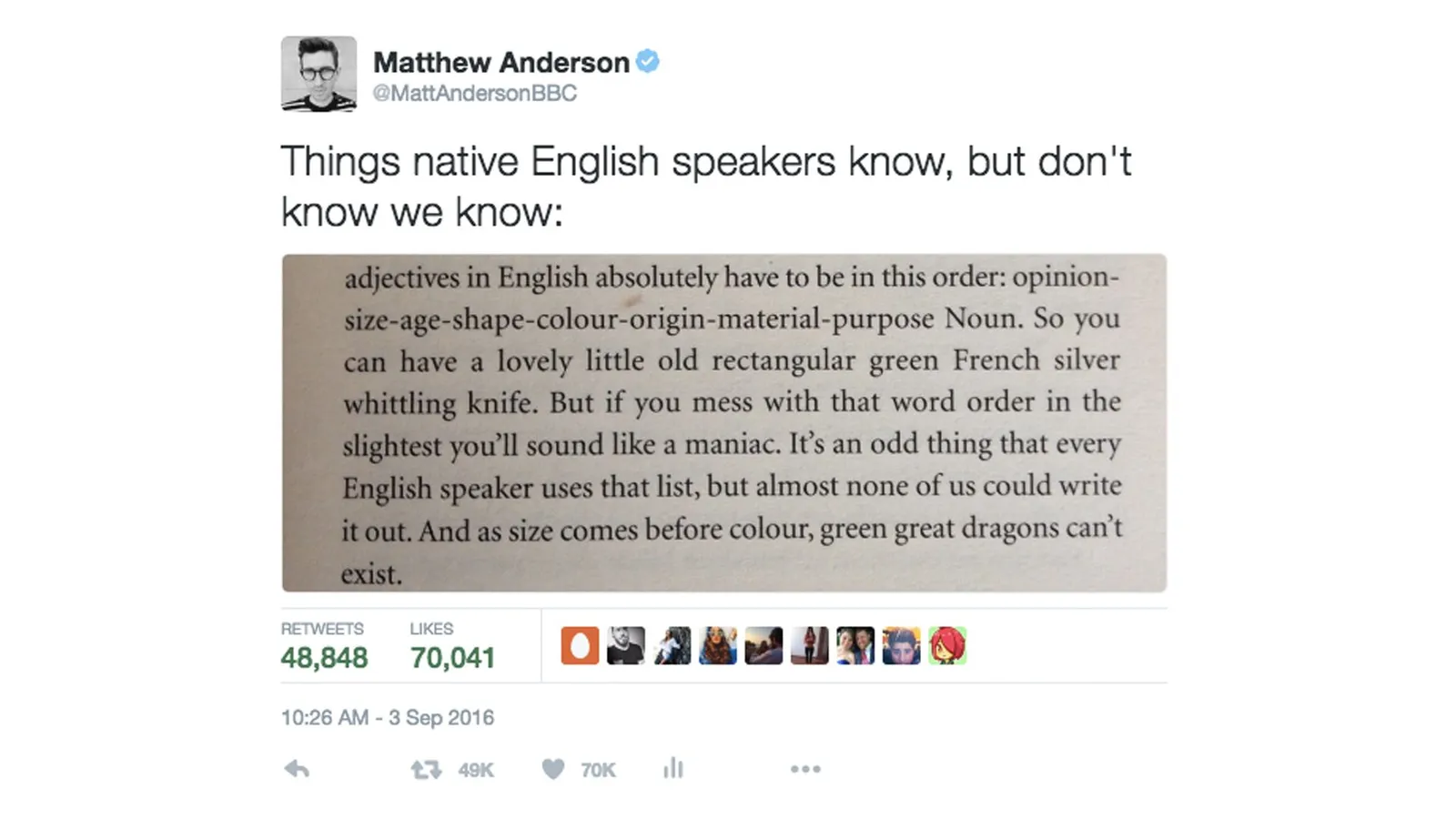
 Adjectives in English absolutely have to be in this order: opinion-size-age-shape-colour-origin-material-purpose Noun. So you can have a lovely little old rectangular green French silver whittling knife. But if you mess with that word order in the slightest you’ll sound like a maniac. It’s an odd thing that every English speaker uses that list, but almost none of us could write it out.”

Actually, there are a couple of small exceptions. Little Red Riding Hood may be perfectly ordered, but the Big Bad Wolf seems to be breaking all the laws of linguistics. Why does Bad Big Wolf sound so very, very wrong? What happened to the rules?

Well, in fact, the Big Bad Wolf is just obeying another great linguistic law that every native English speaker knows, but doesn’t know that they know. And it’s the same reason that you’ve never listened to hop-hip music.

You are utterly familiar with the rule of ablaut reduplication. You’ve been using it all your life. It’s just that you’ve never heard of it. But if somebody said the words zag-zig, or ‘cross-criss you would know, deep down in your loins, that they were breaking a sacred rule of language. You just wouldn’t know which one.


All four of a horse’s feet make exactly the same sound. But we always, always say clip-clop, never clop-clip. Every second your watch (or the grandfather clock in the hall makes the same sound) but we say tick-tock, never tock-tick. You will never eat a Kat Kit bar. The bells in Frère Jaques will forever chime ‘ding dang dong’.


Reduplication in linguistics is when you repeat a word, sometimes with an altered consonant (lovey-dovey, fuddy-duddy, nitty-gritty), and sometimes with an altered vowel: bish-bash-bosh, ding-dang-dong. If there are three words then the order has to go I, A, O. If there are two words then the first is I and the second is either A or O. Mish-mash, chit-chat, dilly-dally, shilly-shally, tip top, hip-hop, flip-flop, tic tac, sing song, ding dong, King Kong, ping pong.


The language rules we know – but don’t know we know
Share on Linkedin
(Credit: Matthew Anderson)
Mark Forsyth tasted internet fame this week when a passage from a book he wrote went viral. He explains more language secrets that native speakers know without knowing.

Article continues below

O

Over the weekend, I happened to go viral. Or rather a single paragraph from a book I wrote called The Elements of Eloquence went viral. The guilty paragraph went like this:

“Adjectives in English absolutely have to be in this order: opinion-size-age-shape-colour-origin-material-purpose Noun. So you can have a lovely little old rectangular green French silver whittling knife. But if you mess with that word order in the slightest you’ll sound like a maniac. It’s an odd thing that every English speaker uses that list, but almost none of us could write it out.”

BBC Culture’s editor Matthew Anderson tweeted a passage from Mark Forsyth’s The Elements of Eloquence and it went viral (Credit: Matthew Anderson)

BBC Culture’s editor Matthew Anderson tweeted a passage from Mark Forsyth’s The Elements of Eloquence and it went viral (Credit: Matthew Anderson)

English speakers love to learn this sort of thing for two reasons. First, it astonishes us that there are rules that we didn’t know that we knew. That’s rather peculiar, and rather exciting. We’re all quite a lot cleverer than we think we are. And there’s the shock of realising that there’s a reason there may be little green men on Mars, but there certainly aren’t green little men. Second, you can spend the next hour of your life trying to think of exceptions, which is useful as it keeps you from doing something foolish like working.

ADVERTISEMENT

Actually, there are a couple of small exceptions. Little Red Riding Hood may be perfectly ordered, but the Big Bad Wolf seems to be breaking all the laws of linguistics. Why does Bad Big Wolf sound so very, very wrong? What happened to the rules?

Ding dong King Kong

Well, in fact, the Big Bad Wolf is just obeying another great linguistic law that every native English speaker knows, but doesn’t know that they know. And it’s the same reason that you’ve never listened to hop-hip music.

If somebody said ‘zag-zig’ or ‘cross-criss’ you would know they were breaking a rule

You are utterly familiar with the rule of ablaut reduplication. You’ve been using it all your life. It’s just that you’ve never heard of it. But if somebody said the words zag-zig, or ‘cross-criss you would know, deep down in your loins, that they were breaking a sacred rule of language. You just wouldn’t know which one.

All four of a horse’s feet make exactly the same sound. But we always, always say clip-clop, never clop-clip. Every second your watch (or the grandfather clock in the hall makes the same sound) but we say tick-tock, never tock-tick. You will never eat a Kat Kit bar. The bells in Frère Jaques will forever chime ‘ding dang dong’.

Reduplication in linguistics is when you repeat a word, sometimes with an altered consonant (lovey-dovey, fuddy-duddy, nitty-gritty), and sometimes with an altered vowel: bish-bash-bosh, ding-dang-dong. If there are three words then the order has to go I, A, O. If there are two words then the first is I and the second is either A or O. Mish-mash, chit-chat, dilly-dally, shilly-shally, tip top, hip-hop, flip-flop, tic tac, sing song, ding dong, King Kong, ping pong.

“What about the Big Bad Wolf?” tweeted many naysayers. But they obviously didn’t know about the rule of ablaut reduplication (Credit: Alamy)

“What about the Big Bad Wolf?” tweeted many naysayers. But they obviously didn’t know about the rule of ablaut reduplication (Credit: Alamy)

Why this should be is a subject of endless debate among linguists, it might be to do with the movement of your tongue or an ancient language of the Caucasus. It doesn’t matter. It’s the law, and, as with the adjectives, you knew it even if you didn’t know you knew it. And the law is so important that you just can’t have a Bad Big Wolf.

Tense situations

It’s astonishing quite how expert you are at the English language. There are so many tenses you can use without even thinking about it, and almost certainly without being able to name them. It depends how you count them, but there are about 20 that you deploy faultlessly. The pluperfect progressive passive for an extended state of action that happened to you prior to another action in the past is, when you put it like that, rather daunting. But then you’d happily say “I realised I’d been being watched” without breaking sweat or blinking. Think how daunting this is for people learning English. The teacher has to explain to them that the English don’t usually use the present tense for things that are happening in the present. “I brush my teeth” doesn’t mean that you’re doing it right now, it just means that you do it regularly. For things that are actually happening right now you use the present progressive “I’m brushing my teeth”.

And having learnt that you then have to learn that there are certain exceptions, like the verb ‘to think’ used as an auxiliary, as in “I think you’re right”. This is why, incidentally, lots of non-native speakers will use phrases like “I am thinking that you are right”. It sounds faintly comic to us, but we had years and years and years of immersion learning just to get all these subtleties. And English is complex and weird. We actually have a tense called the Future Present. Imagine having to learn that. But for us it’s just “The train leaves tomorrow.”


Some rules we really should know. It’s surprising and dispiriting how many English people don’t know the rules of stress, because that’s how all our poetry works. It’s quite easy really, and we can hear it in other languages. Everyone knows that Italian has rhythm, it goes MAM-a MI-a BUON-a SER-a. But so does our language. And that’s how verse works. I can illustrate with my favourite limerick (or at least my favourite clean one). Try reading this aloud:


There was a young man from Dundee

Got stung on the leg by a wasp

When asked does it hurt

He said ‘Yes it does.

‘I’m so glad it wasn’t a hornet.’


That has no rhymes, but it still works as a limerick because rhymes aren’t nearly as important as rhythm. And the rhythm goes:


de-DUM-de, de-DUM-de, de-DUM

de-DUM-de, de-DUM-de, de-DUM

de-DUM-de, de-DUM

de-DUM-de, de-DUM

de-DUM-de, de-DUM-de, de-DUM-de


Saturday, January 22, 2022

The last of God

 By R Wright

Back into Time 


That religious ideas naturally appeal to the human mind doesn’t, by itself, explain how religion got off the ground. Granted that religious “memes” have a “selective advantage” in cultural evolution, how exactly would a given meme—a particular religious belief — first take shape and gain momentum? We’ll never know for sure, but human nature makes it easy to sketch a plausible scenario. 


First, people like to command attention, and one way to do that is to place yourself at the center of dramatic events. In Mark Twain’s The Adventures of Tom Sawyer, Tom Sawyer runs away with his friends Huckleberry Finn and Joe to play pirates on the Mississippi River, and the townspeople conclude that the boys have drowned. Twain describes their friends gathering and talking in reverent tones of how Tom did so-and-so, the last time they saw him, and how Joe said this and that small trifle (pregnant with awful prophecy, as they could easily see now!) —and each speaker pointed out the exact spot where the lost lads Stood at the time, and then added something like ‘“‘and I was astanding just so—just as I am now, and as if you was him—I was as close as that—and he smiled, just this way—and then something seemed to go all over me, like—awful, you know —and I never thought what it meant, of course, but I can see now!” 


Then there was a dispute about who saw the dead boys last in life, and many claimed that dismal distinction, and offered evidences, more or less tampered with by the witness; and when it was ultimately decided who did see the departed last, and exchanged the last words with them, the lucky parties took upon themselves a sort of sacred importance, and were gaped at and envied by all the rest.?? 


There is no reason to think that this incentive to claim special witness to high drama was any less powerful among hunter-gatherers circa 30,000 BCE than among midwestern Americans circa 1900 CE. Imagine that you are one of those hunter-gatherers and you walk past a place where someone died mysteriously, and you hear leaves rustle eerily. That’s a story that will get people’s attention, and you can heighten the attention by stressing how exquisitely timed the rustling was. And, by the way, didn’t you catch sight of a shadowy — almost ethereal —creature out of the corner of your eye? 


The anthropologist Stewart Guthrie has suggested that huntergatherers would be encouraged to make just such false sightings by standard human mental equipment — something called a “hyperactive agent-detection device.” Because the costs of failing to detect a predator lurking in the woods are much higher than the costs of detecting one that isn’t there, natural selection, he plausibly argues, may have biased our brains toward “false positives”: you hear a rustling, your mind flashes the vivid hypothesis of some generic animal that’s doing the rustling, and you turn toward it expectantly. Did you actually see something? Kind of. 


In any event, if upon recounting your eerie encounter you get caught up in the spirit of the story and say you saw an ethereal being, then you may convince not just your audience, but yourself. One notable finding of modern psychology is how systematically misleading memory is. People often remember events wrongly from the get-go, and even when they don’t, their memory can later be steered toward falsehood. In particular, the act of reporting false details can cement them firmly in mind. You don’t just recount what you remember, you remember what you recount.”4 (Football star O. J. Simpson’s former agent was sure Simpson had killed his ex-wife and also sure that Simpson believed he didn’t.)*5 This built-in fallibility makes sense from a Darwinian standpoint, allowing people to bend the truth self-servingly with an air of great and growing conviction, And, clearly, bent truths of a religious sort could be self-serving. If you were a Close friend or relative of the deceased, then the idea that his powerful spirit is afoot may incline people to treat you nicely, lest they invite his wrath. 


Another gem from social psychology: publicly espousing something not only helps convince you of its truth; it shapes your future perception, inclining you to see evidence supporting it but not evidence against it.7° So if you speculate that the strange, shadowy creature was the disgruntled spirit of the deceased, you’! likely find corroboration. You may notice that one of his enemies fell ill only a week after your sighting, while forgetting that one of his friends fell ill a few days earlier. 


If you’re a person of high status, all of this will carry particular weight, as such people are accorded unusual (and often undue) credibility. If, in a hunter-gatherer band of thirty people, someone widely esteemed claims to have seen something strange — and has a theory about what it was—twenty people may be convinced right off the bat. Then the aforementioned tendency of people to conform to peer opinion could quickly yield unanimity.’ 


The number of mental tendencies involved in the creation and nourishment of religious falsehoods shouldn’t surprise us. After all, the mind was built by a process that is, strictly speaking, indifferent to truth. Natural selection favors traits that are good at getting their bearer’s genes into the next generation, period. If saying something false, or believing something false, often furthered that goal dur ing human evolution, then the human mind will naturally encoulage some kinds of falsity. This systematic muddle isn’t an exclusive property of the “primitive” mind, as John Lubbock (chapter I) suggested: all of the above delusory tendencies have been documented in people living in modern societiesmany of them students at fine universities! 


So why are people in modern societies so often aghast at “primirive” religion, so unable to comprehend how “primitive” belief got started? In part, it is the classic human failure of objectivity —an inability to see that your own beliefs may seem as strange to others as theirs seem to you. (An African Pygmy once responded to a missionary’s description of heaven by asking, ““How do you know? Have you died and been there?’’) And in part it is a failure of imagination. Imagine that you are living in a smal] encampment surrounded by jungle or woodland or desert, entirely untouched by science and modern technology. Within the encampment, the social universe operates by largely intelligible laws; people don’t generally, say, fly into a rage and assault their neighbors without a cause of some sort or another. But from outside this universe come mighty and momentous forces—storms, droughts, deadly animals, fatal illness. You are viscerally interested in explaining and controlling these things; you readily absorb and repeat any news or conjecture bearing on this goal. And, above all, you are only human. The rest is history. 


Thinking and Feeling 


This view of religion’s origins—the view from modern psychology—is in some ways just an updated version of Edward Tylor’s view: people first conceived of gods and spirits to explain the unexplained. Indeed, Tylor even seemed to vaguely anticipate the modern focus on reciprocal altruism: “Spiritual beings are held to affect or control the events of the material world, and man’s life here and hereafter; and it being considered that they hold intercourse with men, and receive pleasure or displeasure from human actions, the belief in their existence leads naturally, and it might almost be said inevitably, sooner or later to active reverence and propitiation.”?* 


Still, there is a difference of emphasis. When Tylor says belief in gods “leads naturally” to their propitiation, he seems to mean that this progression was logically natural—that extended reflection led eventually to the conclusion that giving gods respect and foodstuffs would satisfy them. An evolutionary psychologist, 1n contrast, might stress how viscerally natural this propitiation 1s; it feels like the right thing to do. Tylor’s oft-ridiculed reference to “ancient savage philosophers” (see chapter 1) does indeed connote more in the way of cool, detached reflection than was probably operative — and than is operative generally in human beings. Some features of the mind that undergird religious belief are “cognitive” traits that guide our “intellectual” lives but are also shot through with feeling. 


Saturday, January 15, 2022

Last batch of clippings

S. SCHAMA 

A constant refrain throughout this long literature of complaint, and what European intellectuals even now find most repugnant, is American sanctimoniousness, the habit of dressing the business of power in the garb of piety.

Other characteristics of American life alienated the Romantics: the distaste for tragedy (a moral corrective to illusions of invincibility); the strong preference for practicality; the severance from history; and, above all, what the Germans called Bodenlosigkeit, a willed rootlessness, embodied in the flimsy frame construction of American houses. Europeans watched, pop-eyed, while whole houses were moved down the street. This confirmed their view that Americans had no real loyalty to the local, and explained why they preferred utilitarian “yards” to flower gardens. No delphiniums, no civility. 


‘The British who arrived in the United States in the eighteen-thirtes and forties had imagined the young republic as a wide-eyed adolescent, socially ungainly and politically gauche, but with some hint of promise. What they found was a country experiencing an unprecedented growth spurt, both territorial and demographic, and characterized by an unnerving rudeness, in both senses of the word. Ladies and gendemen dodged quids of tobacco juice and averted their gaze from the brimming cuspidors thar greeted visitors to steamboat saloons and hotel and theatre lobbies. The hallmark of Jacksonian America seemed to be a beastly indifference to manners, the symptom of a society where considerateness to others was a poor second to the immediate satisfaction of personal wants. 


The conduct of Americans at dinner said it all. They wolfed down their food, cramming cor bread into their sloppy maws during meals that were devoured in silence, punctuated only by slurps, grunts, scraping knives, and hacking coughs. (All those cigars.) At the Plate House in the business district of New York, naval captain and travel writer Basil Hall was astonished by the speed at which the comed beef arrived and then by the even greater speed at which it was demolished: “We were not in the house above twenty minutes, but we sat out two sets of company at least.” Only the boy waiters yelling orders at the kitchen broke the quiet. The lack of polite conversation suggested the melancholy and dispiriting monotony of American life, on which almost all the early reporters commented. Tocqueville explained the apparent paradox of anxiety amid prosperity as the result of the relentless obligation to be forever Up and Doing. 


The European commentators’ dismay at the tyranny of American materialism was disingenuous, since many of them had come to the United States to repair their tattered fortunes or make new ones. Frances Trollope decided to sojourn in America when a rich uncle did the Trollopes the disservice of marrying late in life and, still worse, begetting an heir. Fanny Wright, whose ardor for America had been relit by the Marquis de Lafayette’s triumphal tour in 1824 and 1825, visited Mrs. Trollope at her expensive rented house at Harrow 

....who were barely subsisting. Of the all important school there wits no sight and no prospect. Mrs. Trollope, aghast at the filth and the fever-bearmg mosquitocs, fled with her childten to Cincinnati, which was, alas, an “uninteresting mass of buildings,” where hogs rooted in the streets. Together with the French painter Auguste Hervicu (who had intended to teach at Nashoba), she flung herself into show business, remodelling a “Western Museum,” . which had hitherto been a _ collection of natural curiosities and patriotic waxworks. Her son Henry became the Invisible Girl, booming prophecies  in creepy darkness, and, with the help of glass transparencies, she created a vision of the Infernal Regions, featuring frozen lakes with erupting fountains of flame, and electric shocks should the customers, peering through grates, try and touch the exhibits. Mrs. ‘Trollope’s next venture, a galleried, gaslit emporium of consumer wonders, stocked with fancy goods supplied from Harrow by her husband, ended in debt practically before it began. 

Hollywood movies.. for the illiterate, for poor creatures stupefied by work and anxiety,” were the Trojan horse for the Americanization of the world. Jean Baudrillard’s belief that the defining characteristic of America is its fabrication of reality was anticipated by Duhamel’s polemics against the “shadow world” of the movies, with their reduction of audiences to somnolent zombies sitting in the dark. 

&

A headline in the Times of July 22, 1948, read “GORKY 'S COUSIN ENDS LIFE.” According to the brief obituary that followed, a Russian born American painter, forty-five years old, had hanged himself in a barn on his property in Sherman, Connecticut. The story was full of errors. The painter, Arshile Gorky, was unrelated to the celebrated Communist writer Aleksey Peshkov, whose pen name was Maxim Gorky. He was probably forty-eight years old, and was born Vosdanig Adoian, in a village in Turkish Armenia. The Sherman property wasn't his—he was too poor to own much of anything and tne building that he selected to die in was a shed. The obit’s major errors repeated lies that Gorky regularly told about himself. He kept secret his memories of the massacres, famine, and epidemics that decimated his people during the First World War. He spoke passionately of his mother but rarely of her death in his presence, at the age of thirty-nine, perhaps of starvation. 

Herrera begins her book with a barbaric scene. In 1903, in an ancient monastery church near Lake Van, Turkey, “Arshile Gorky’s grandmother, the widow Hamaspiur, had brought the family together to hold a vigil for her youngest son, sixteen-year-old Nishan, who had vanished several days earlier. She suspected that he had been abducted by Kurds, for he had fallen in love with a Kurdish girl whose brother took offense. ... Only five years earlier, her husband, Sarkis Der Marderosian, the last of a long line of Armenian apostolic priests, had been nailed to the door of the church where he served in Van City.” As the family prayed, there was a thud at the door. Outside, they found Nishan’s blood-drenched body. Months of wild grief later, “to revenge herself against God,” Hamaspiur set the monastery church on fire. “Arshile Gorky would look back with admiration at his grandmother's rebellious spirit,” 

Rejecting his father’s expectation that he would be a factory worker, Gorky enrolled in Boston’s New School of Design in 1922 and dove into the study of art, partly in schools but mainly in museums. He was savagely proud. When a teacher disparaged his work, he destroyed the canvas that he was working on and walked out of the class for good. He took menial jobs and earned money for a time on the vaudeville stage, chalking likenesses of American Presidents, one a minute, on a blackboard. He later told of swimming out into the Charles River to drown himself and being driven back to shore by the sudden thought, “What about painting?” In 1925, he moved to New York, where he became a charismatic teacher (one of his students was Mark Rothko) anda dashing presence. In 1929, he moved into a space at 36 Union Square which he rented for the rest of his life. Herrera writes that Gorky would stride into the square in “a long black overcoat, a red scarf, and either a proletarian-looking wool knit cap or, on days when he wanted to look prosperous or gangsterish, a black felt hat tilted forward over his eyes.” He haunted museums. His favorite Old Masters were Uccello and Ingres, both of them radical engineers of style. One day at the Metropolitan, a woman reacting to his long hair and beard quipped, “Are you Jesus Christ?” He answered, “No, Madam. I am Arshile Gorky.” He had | settled on the name in Boston, after toying with Archie Gunn and Archie Colt both inspired by Western films. 

Gorky ‘shied away from girls, a friend said. “But girls didn’t shy away from him.” He idealized and was awkward with women, whom he called, fancifully, “skybabies.” He was chary of ~ sex. One former girlfriend told Herrera, _ “You thought that at the back of his mind, even while having intercourse, _ he was thinking, ‘Oh my goodness, all. my strength is going! I should save itup for painting!” When trouble arose between them, the same woman said, “The only way he could deal with me was to get hysterical and hit me and threaten suicide.” 

&

His name was Eric Vachell, except that it wasn't. He was known to me as Uncle Eric, but he was not my uncle. He was born an Anglican and died a Roman Catholic. He never married, because of something he had read in a book. He was a doctor who was laid low by the suffering that he witnessed. He was never famous, and his existence is now recalled by fewer than a dozen people in the world. More than twenty-five years after his death, however, he 1s still a pervasive in{xc xce on my life. And here's the strang-est th.tic T never met him. Ever that is not quite true. I did meet - Eric, but only at my christening, when I was not yet fit for human society. He was present that day, attending what was, by any standard, a minor event in the social calendar, because he was my great-uncle- the brother of my maternal grandfather. = I was wearing diapers at the time, and was therefore ill-equipped to engage Eric in discussion of his favored topics, such as Catholic doctrine and herbaceous borders. Even now, though, I wonder whether he did not lean over my crib and confer some murmured blessing: a hint of the link that would bind us. 


That was our final encounter. I never saw him again—it was tacitly understood that Eric’s preference was for children of the unseen variety—and we never spoke on the telephone. Eric, born in 1897, hailed from a generation that mistrusted the phone and put its faith in letterwriting. According to my late mother, his niece, all his letters began with the phrzse “The weather is not clement ‘n tic 73° This was unsurprising, Hovs hc... z small town on the south coas. tf £ 2 gland to which, by traditicn, +: elderly have retired, there to stagger through tempests of ozone-rich breeze. 

Anthony Lane. Beyond a Joke 2004


Tuesday, January 04, 2022

Keats brother and other clippings

 If Keats’s father was thrown from his horse, Keats's mother was thrown by this accident from life, never really to recover. Nor did her family, which henceforth lived in permanent disarray Frances Keats abandoned her family for an unfortunate second marriage, a mere two months after her husband's death, which, under English marital law of the day, denied her children their legal patrimony. Her second marriage ended in separation two years later. Meanwhile the Keats children, essentially orphaned, lived with their grandparents. The original plan was to send the Keats boys to Harrow, but this had to be abandoned when thet maternal grandfather, with whom the children were living, died in 1805. Five years later their mother would die, of what has ame been thought tuberculosis, which would eventually kill Keats’ youngest brother Tom in 1819 and eventually John Keats himself. at his lodgings at 26 Piazza di Spagna in Rome, and, later still, kill his brother George, then in his early forties, in Louisville, Kentucky, 

&


‘France in the Enlightenment,” first published in French five years ago and now expertly conveyed into English by that canonical translator of our time, Arthur Goldhammer, is the best cultural history of that extraordinary episode now available. Drawing on a whole generation of new work, it shares the fundamental premise of most historians now. active in the field: that to study the Enlightenment is not simply, or even primarily, to study the origins of the French Revolution..Contemporaries did not know what would happen next. That was precisely why the Revolution came as such a shock. And to write the history of a whole century in terms of its last 10 years, however momentous, can only distort historical perspectives on three or four earlier generations, unaware of or indifferent to what would befall their descendants. It is not that the Revolution is entirely absent from Roche’s portrait of the age. But instead of scouring the Enlightenment for symptoms of revolution, he quarries the Revolution for echoes of the Enlightenment. For this is a study of cultural transformations in the broadest sense: how the outlook and behavior of a whole society evolved between the death of Louis XIV and the collapse of Louis XVI's monarchy, The first section describes the face of the kingdom, its socloeconomic structure and the way pervasive urbanization was forcing all those who lived in cities to change their habits and expectations. The second part takes us through the world of public affairs in a time when conflicts were no longer resolved by force of arms or rebellion, but not yet by debates and votes in representative assemblies. To an extent scarcely understood before the current genera tion of historians, political disagreements were still couched in religious language, and claims were staked in terms of jurisdiction rather than rights. But as the century went on, the elites on whom the monarchy traditionally relied were finding the institutional apparatus within which they operated increasingly unrewarding. They articulate their dissatisfactions in the language of the Enlightenment, to which a third and final part, “Enlightenment and Society,” is devoted. But the Enlightenment was not, as used to be thought, an ideology of opposition. The rich range of quotations enlivening Roche’s text shows an age keener to analyze and reflect than to denounce. And although one of the most momentous cultural developments of the century was the emergence of an independent public opinion, no longer contolled by authority, it is far from clear whether authority really wanted to control it any longer. The public sphere, after all, being public, did not exclude the government; and as the century went on the Kings’ ministers came to see more advantage in trying to influence and lead public opinion than in trying to stifle its expression. 


PUBLIC debate was educative. Conducted by civilized people, it could pre-empt more problems than it created. And so the state was an increasingly active participant in the cultural world of the Enlightenment. It encouraged the proliferation of academies; sponsored reform in the church; tried to impose rationality on urban expansion; groped toward freeing the grain trade and colonial commerce; and engaged on all these fronts with the most advanced ideas of the day in order to improve the lot of the Kings’ subjects. By the reign of Louis XVI, ministers had even introduced some representative institutions to channel the cooperative energies of men of wealth and leisure into the grand project. 


Never was government more enlightened than in its belief in the self-evident rightness of such policies. The rhetoric of the Enlightenment took for granted the sureness of its own analyses, and perhaps the most fateful flaw in the enlightened mind-set was its failure to find space for legitimate disagreement. Yet the interests threat


 Yet the interests threatened by enlightened reform were not paper tigers, nor were they confined to a few bloated enclaves of privilege. Implementing enlightened reform posed challenges to every level of society, as the testimony of the inimitable Meénétra is repeatedly invoked by Roche to show. What destroyed the ancien régime, along with the world of the Enlightenment portrayed in this book, was a collapse of confidence. While the impatient enlightened elites lost faith in the monarchy’s halting commitment to progress, those below the level of their notice felt betrayed and bewildered by the pace of change and reform. And so when it entered its final agony, the French version of enlightened absolutism found itself without support from anyone, enlightened or otherwise. 

&

Teachout on Powell

In fact, issuing orders is Widmerpool’s only real sensual pleasure, and it is at least as significant that he is a teetotaling philistine as that he may have helped sneak Guy Burgess and Donald Maclean out of England. Whenever Powell: informs us that one of his characters takes no pleasure in drink or the arts, or that he prefers power to love, it’s a safe bet that unsavory revelations are just around the corner. Herein lies the theme of ‘‘A Dance to the Music of Time,’’ stated explicitly in ‘‘A Buyer’s Market’’  (1952), the second volume, in which Jenkins remarks that ‘the arts themselves, so it appeared to me as I considered the matter, by their ultimately sensual essence, are, in the long run, inimical to those who pursue power for its own sake. Conversely, the artist who traffics in power does so, if not necessarily disastrously, at least at considerable risk.”’ Some will doubtless find this distinction a recondite premise on which to erect a 12-volume novel.


In any case, few great novels -and I incline increasingly to calling ‘‘Dance’’ great — are altogether free of flaw. In ‘““Messengers of Day’ (1978), the second of his four volumes of memoirs, Powell dilates briefly on the ‘“‘vulgarity”’ and *““implausibilities’’ of Balzac before dismissing them as unimportant: ‘‘Besides — something never to be forgotten — with all novelists one must put up with something.” To read ‘‘Anthony Powell: A Life’ and ‘‘Understanding Apthony Powell’’ is to be reminded of just how much “‘A Dance to the Music of Time” is worth putting up with. 

&

The years of vaudeville — from the 1880’s to the 1930’s — is entirely like that: an eerie familiarity peeks through its alien surface. It’s like seeing a family photograph in which ancestors bear an uncanny resemblance to their living descendants. 


For it was during this period that American popular culture began to take shape. And the minstrel singers, circus acts, ethnic comedians, cross-dressing entertainers, chorus line beauties and early jazz performers, who were booked in ornate theaters across the country by a new class of managers and agents, may have been sSuperseded by 20th-century entertainments, but not before shaping the future of Broadway, radio, film and American culture. 


There's something about thie that goes to the very heart of vaudeville Under the leadership af producers and theater owners like Tony Pastor, in the late 19th century, vaudeville tranaformed the taucoua and ribald variety acta thal had heen a etaple of American entertainment Vaude Ville, in its prime, made ii-repute reputable Women and children could sometimes attend When live performances and film were com bined tn the early picture palaces of the 1920's, theaters included play rooms with toy carousels 


But impulses and attitudes within vaudeville remained at the very edge of respectability. Its stock characters were representatives of particular ethnic and racial groups — blacks and immigrants — and all were presented in caricature. Blackface singers like Al Jolson were imitating the way black singers showed themselves in vaudeviile’s version of minstrelsy. Irish, German and Yiddish accents were part of the patois of vaudevillian comedy, the mangled sentences echoing the increasingly familiar immigrant sounds of cities like New York. 


Oddly, though, these exaggerations were not generally an occasion for bigotry or hostility. There was an element of celebration wm Uke mockery, partly because the actors were often themselves from these groups. Even stranger, eho actors would adopt alien ethnic identities for the sake af the comedy, making the artifice even more apparent. Blacks appeared as Chinese, Jews as Irish. it was as if, by some unspoken agreement, Marginal groups had joined forces in displaying, to each other, “the comic absurdity of their position. 

&


...“pelvic hyperemia,” or congestion of the genitalia. 


Vibrators were also marketed to women, as home appliances. In fact, the vibrator was onty the fifth household device to be electrifred, after the sewing machine, fan, teakettle and toaster, and preceding by about a decade _ the vacuum Cleaner and electric iron — perhaps, Dr. Maines suggests, “‘reflecting consumer priorities.” 


Advertised in such respectable periodicals 2s Needlecraft, Woman’s Home Companion, Modern Priscilla and the Sears, Roebuck catalogue, vibrators were pitched as ‘“‘aids that every Woman appreciates,” with the delicious promise that “all the pleasures of youth ... will throb within vou.”’ 

 Sigmficantly”’ the vibrators were almost always designed to be used externally. As a result, medically indicated massage therapy could be pitched as upstanding and asexual — and less risque than the gynecologist’s speculum, which came under heavy ethical fire when it was first introduced in the late 19th century. 


Dr. Maines, head of Maines and Associates, a firm that offers cataloguing and research services to museums and archives, first stumbled on her piquant subject while researching the history of needlework. Thumbing through a 1906 needlepoint magazine, she found, to her astonishment, an advertisement for a vibrator. When she realized there was no stholarly history of the device, she decided to take on the topic. 


Her investigations led her to conclude that doctors became the keepers of the female orgasm for several related reasons. To begin with, women have been presumed since Hippocrates day, if not earlier, to suffer from some sort of ‘“womb furie’’....


&

Flaubert urged Maupassant to describe something common —and then search for the “unexplored” element in it. According to Flaubert, even the commonest thing contains something that no one has noticed, “because we are accustomed to seeing things only through the memory of what others have said about them.” Next, Maupassant recalled, “he forced me to describe, in a few phrases, a creature or an object so that it was ciearly distinguishable from all other creatures or objects of the same race or species.” 


What's funny

 According to WC Fields

....wolfhound. i stopped. They walked from one wing to the other. 

‘My,’ I said, ‘what a beautiful camel.’ That got a laugh, and the act was a success. 

The golf act was introduced in the Follies of 1918, though it was clearly extant in 1915, as the vanished second Gaumont film attests. In gnother magazine article, for The American, in 1934, Fields told the sale a little differently. The article, ‘Anything For a Laugh’, opens a window into the comedian’s trial and error, the painstaking process of finding out which gag and what line works best. At first, he says about the incident with Ziegfeld, he tried using the word ‘horse’: ‘I experimented night after night to find out what animal was the funniest. I finally settled upon “That’s a very beautiful camel.”’ Fields continued: 


The funniest thing about comedy is that you never know why people laugh. I know what makes them laugh, but trying to get your hands on the why of it is like trying to pick an eel out of a tub of water... 


You usually can’t get a laugh out of damaging anything valuable. When you kick a silk hat, it must be dilapidated; when you wreck a car, bang it up a little before you bring it on the scene. 


It is funnier to bend things than to break them — bend the fenders on a car in a comedy wreck, don’t break them off. In my golf game, which I have been doing for years, at first I swung at the ball and broke the club. Now I bend it at a right angle. If one comedian hits another over the head with a crowbar, the crowbar should bend, not break. In legitimate drama, the hero breaks his sword, and it is dramatic. In comedy, the sword bends, and Stays bent... 


I know we laugh at the troubles of others, provided these troubles are Not too serious. Out of that observation I have reached a conclusion which may be of some comfort to those accused of ‘having no sense of humor.’ These folks are charming, lovable, philanthropic people, and invariably I like them — as long as they keep out of the theatres where I am playing, which they usually do. If they get in by mistake, they leave early. 


The reason they don’t laugh at most gags is that their first emotional reaction is to feel sorry for people instead of to laugh at them. 


I like, in an audience, the fellow who roars continuously at the troubles of the character I am portraying on the stage, but he probably has a mean streak in him, and, if I needed ten dollars, he’d be the last person I'd call upon. I’d go first to the old lady and old gentleman back in Row S$ who keep wondering what there is to laugh at. 


Of course, many comedians did get laughs out of breaking, rather than bending things, for example, Laurel and Hardy. But Fields always had strained relations with objects that got out of shape, or appeared on the scene misshapen from the source. The very building blocks of his reality were skewed. Thus, as J.B. Priestley observed, even when he stopped juggling as an act, he still had to juggle with life itself, with every small thing, at every corner. 


As the Follies liberated him from the juggler’s routine, he began devising his own scenarios. It was long since he had confessed to O. K. Sato his clumsiness at the typewriter and the recalcitrant pages. We don’t know when Fields began writing his ‘vaudeville scripts’, some of which may have predated the Follies. But it was during the Follies that he sat down, in his hotel apartment, and began methodically churning them out. 


Where do comedians get their material? The answer is usually, from other comedians. Comedians found their jokes in joke books and humourous magazines and revamped them to fit their act. George Burns wrote: 


Performers would take material from anyplace they could find it. Harpo [Marx] told me about a theatre the Marx Brothers played in Fargo, North Dakota; the manager had hung up a big sign in the wings listing about 100 jokes and the warning, THESE JOKES HAVE ALREADY BEEN USED IN THIS THEATRE — DO NOT USE THEM. And nobody used them there, but everybody wrote them down and put them in their act for the next booking. 


Nat Wills, one of vaudeville’s greatest draws, was known to have been a regular subscriber to Madison’s Budget, a joke magazine published between 1898 and 1918. It sold for one dollar and was a treasure house of comedy gags and situations. Later the author, James Madison, sold complete sets of his old journals to comedians like Eddie Cantor and Fred Allen. 


In the vaudeville days, the only way a comedian could protect material was to seal it in an envelope and send it to Pat Casey, of the Vaudeville Managers’ Protective Agency. But this was not a foolproof method. Fields, like other professionals, lived in a constant anxiety that carefully worked out routines would be pilferred by rivals, 


The censors:

Delete underlined words in the line “I can’t go to bed, I'm not married yet.”... Delete action of Fields looking in keyhole, including line, “What won’t they think of next.”’ And of course, the whole pussy sitting scene, once again. 


At its initial release, the film was approved without cuts only in two states - New York and Kansas. In Pennsylvania they eliminated the underlined words — “Tommy, don’t you see we’ll never be married; you just can’t take the strain.’ In Virginia, the nuts and bolts had to go. In Maryland, they didn’t like the line ‘Oh, doctor, I can hear my heart beat.’ In Ontario — ‘Don’t let the posy fool you.’ In Ohio, 8 deletions, including Quail’s line to Peggy, when he tells her he’ll come back to collect her: ‘Don’t forget, tap on the window as soon as the chumps leave.’ 


It should be noted that America was far from the only country seething with puritanical fever: in Australia, the censors were even more cautious, deleting — ‘I’ll be down as soon as I take off these pajamas.’ And in Japan, they took umbrage at Peggy Hopkins Joyce taking some shorts out of a suitcase and saying to the besotted Tommy: ‘I packed these by mistake in the desert.’ In Sweden the whole film was ‘CONSIDERED UNSUITABLE - Story too artificial and absurd.’ 


When we watch International House today, we are struck at the carefree innocence of these 1930s comedies, with all their silly twists and turns. But it is salutory to realize with what horror such high jinks were regarded by the censorship boards of the day. From that point on, Breen had Fields’ number, as an unconscionable vulgarian, who would get away with murder, obscenity and every other transgression in the censor’s book, if only he could. The battle lines had been quite sharp drawn. 


&

It was in this period that the eccentric artist, John Decker, painted a portrait of W. C. Fields as Queen Victoria. In the world outside the Hollywood cocoon, World War II had broken out — on x September, Germany invaded Poland, and on 3 September, Great Britain declared war on Germany. But this was happening quite far from Los Angeles. 


John Decker, none the less, had more cause than most of his friends to worry about events in Europe since, as he would later reveal to Gene Fowler, he was in origin a German national, whose real name, he claimed, was Leopold Wolfgang von Decken. Son of a German Baron and his San Franciscan bride, he had fallen foul of a mix up in the First World War involving a forger of Old Masters, from whom he had learnt his craft of copying, and who, as a sideline, sewed messages to Berlin in the double-canvases of his forgeries. As a result, Decker had spent the war in an English prison camp on the Isle of Man as a suspected spy, and his friends, after the war, had arranged his passage to America by means of a fake passport. Now he was living in a hillside studio in Hollywood earning his keep by painting stars like Clark Gable, Fanny Brice and Harpo Marx in the manner his disastrous mentor had taught him. (But without the secret messages.) The outbreak of war was to kindle his old fears of internment. 


Neither Gene Fowler nor anyone else was able to verify this shaggy Hun story. But Decker’s studio, which was soon moved to a new property in Bundy Drive, Brentwood, was to become the central hub for the coterie of dilapidated old masters such as Bill Fields, Gene Fowler and John Barrymore. The Queen Victoria portrait was requested by Gene Fowler, who hung it in his office, resisting Fields’ poignant cry of ‘Sabotage! Decker has kicked history in the groin!’ 


Fowler remembered the day he hung the portrait well, because it was also the day on which he adopted an even stranger new member of the Old Boys’ convocation: the crazy Japanese-German Sadakich! Hartmann. 


In 1954, Gene Fowler published his memoirs of this period, entitled Minutes of the Last Meeting. Fowler’s book is by far the most distincve account that has come down to us of the private side of W. C. fields’ last years. It is not a biography of Fields, since Fowler had ceded this task to Robert Lewis Taylor. Having already written his biography of Barrymore, Goodnight, Sweet Prince, Fowler decided to focus on the extraordinary Sadakichi as the hub of his tale of the Twilight of these Hollywood Gods. 


Sadakichi, in fact, was probably known to both Fields and Barrymore from their drinking days in the Lambs Club. Sadakichi Hartmann was the son of a German father and Japanese mother, born in Nagasaki in 1867. His father took him to Germany to be educated and from there he travelled to America in 1885, where he specialised in the history of art. He became a kind of unpaid secretary to Walt Whitman, who later cast him out for revealing his caustic views on fellow artists. Back in Europe, he became acquainted with Mallarmé and Verlaine. A grade-A leech, he set out on a life-long career as a celebrity groupie. Bill Fields said of him scathingly: ‘He has been a peeping tom, a cap-and-bell interloper at all the art shrines.’ But Barrymore adored him, as the ultimate offender against the pretensions of high society, and dubbed him ‘the last of the Pharaohs, and nicely mummified at that’. 


Sadakichi knew no boundaries. He was the ultimate egotist, who would yell, when told that a toilet was around the corridor: ‘Bring it to me!’ Or he would cry out: ‘Other people talk and talk about dying. I’m doing it!’ At the turn of the century, he had been the self-styled ‘King of Greenwich Village’, and had in fact published two volumes of an important History of American Art. He had pioneered the appreciation of early photographers, such as Stieglitz, Henry Havelock Pierce and Frank Scott Clark, as well as publishing a blasphemous book called The Last Thirty Days of Christ, in which Christ was enamoured of Mary Magdalene. He was well ahead of his time, but by the late 1920s he was already an established sponger. By the early 1940s, he was a physical wreck, staggering about with a homemade truss which supported a great scrotal hernia. Sadakichi’s perverse admirers called him The Gray Chrysanthemum.