Wednesday, March 09, 2022

Ukraine

 By Timothy Garton Ash

Last autumn Ukraine imprinted itself on the political consciousness of the world for the 1st time in its history. And what was christened the Orange revolution vast crowds were in Orange scarves gathered in subzero temperatures in Kiev's independence square to demand a fair election for president. They won. Under its new president, Vitor Yushchenko, Ukraine can move toward what he and his allies hope will be a working democracy and market economy under the rule of law. and toward membership in the European Union. 


 Observers have placed Ukraine's “orange revolution™ in a sequence of peaceful democratic revolutions stretching from the “velvet revolutions” of 1989 in Central Europe, through the “rose revolution” in Georgia in 2003. to what some are already calling the “cedar revolution” in Lebanon. Many Ukrainians are understandably delighted by this attractive labeling, so different from the largely negative or Nonexistent image they have had in the past. Yet we must look beyond the news headlines to discover how and why this change has come about, and what its consequences may be. 


The history of Ukraine begins a thousand years ago, when the rulers of a trading stale based in Kiev—or Kyiv, to use the Ukrainian spelling, converted to Byzantine Christianity. After the Mongol invasions, Kyiv and surrounding lands were absorbed by the then combined state of Poland-Lithuania, in which Ukrainians were exposed to the influence of the Renaissance and the Counter-Reformation. As Russian power extended westward, educated Ukrainians offered their services to the Russian empire. The Ukrainian language, related to both Polish and Russian, allowed them to assimilate easily. As nationalism emerged in the nineteenth century, Russians came to see Ukraine as a branch of their own nation. At the same time a Ukrainian national movement began to articulate a distinctive Ukrainian culture. However, Ukraine failed to achieve independence in 1918. Attempts by Ukrainians to found a state were blocked by Bolshevik and Polish forces. Woodrow Wilson did not think Ukraine was a nation, and the Western powers conceded Ukrainian lands to the Russian White Armies in the hope that they would defeat Bolshevism. In 1921, Ukraine was divided up between the Boisheviks and Poland.' The Bolsheviks granted Ukraine generous space within the new Soviet Union, but the peasantry in Soviet Ukraine was destroyed by the collectivizanion of agriculture, while the Orthodox Church was subordinated and corrupted, and the intelligentsia was decimated. Among Stalin’s worst crimes was the organized famine of 1932 1933, which took the lives of at feast three million people in Soviet Ukraine. His regime was displaced in 1941 by the Nazis. who regarded Ukraimans as racially inferior, and brutally treated them as such. Ukraine's Jewish population was all but eliminated in the Holocaust, in which the German occupiers were aided by the collaboration of a minority of Ukrainians. Some Ukrainian nationalists attacked and killed local Poles. Hundreds of thousands of Ukrainian soldiers starved to death in German camps. Yushchenko’s father, who survived Auschwitz. was one of the lucky few. With the return of Soviet power at the end of the war Ukrainian lands were gathered into one pohtical unit. In 1945. Stalin annexed western Ukraine from Poland. thereby bringing people with a different experience of politics into the Soviet Union. Some of them came from Galicia, a part of Austna between 1772 and 1918 that was incorporated into Poland. These Ukrainians were mostly Greek Catholics, their “uniate” church combining an Eastern liturgy with subordination to the Vatican. Between the two wars the Galicians had been citizens of Poland, which, while an increasingly authoritarian state, generally allowed free expression and accepted the rule of law. After 1945 Nikita Khrushchev, the Communist official in charge of Ukraine, took control of the Soviet pacification of its western part. It was he who added the Crimean peninsula to Soviet Ukraine in 1954, giving the country its present shape. 


Soviet power weakened or celiminated in Ukraine those elements of civil societyprivate farms, churches, the intelligentsia—that had helped to prepare the way for the velvet revolutions in its more fortunate neighbors, such as Poland and Czechoslovakia. Sull, when the USSR collapsed in 1991, Ukraine had a name, a capital, a place on the map. But its independence arrived without a major popular movement to shape it.” Its foundations were fragile. Many in Russia refused to accept the reality of Ukrainian independence.


During the 1990s, Ukraine was an electoral democracy undergoing a shaky transition to a post-Soviet version of capitalism. Between 1994 and 2004, the regime of President Leonid Kuchma. in which the President appointed almost everybody that mattered. adopted increasingly corrupt, brutal, and undemocratic methods. Kuchma pioneered what has been called “the blackmail state.” Having itself encouraged widespread corruption, his administration blackmailed officials and private citizens by threatening them with evidence of wrongdoing gathered by the secret policesuch evidence being known as kompromat, the old Soviet term for “compromising material.” Kuchma also cultivated intimate relations with some of Ukraine’s new industrial barons, letting them take over state assets—particularly coal, steel, and natural gasand giving them other favors in return for their political support. The system seemed to work. 


After World War I, the Ukrainian conservative Vyacheslav Lypyns’kyi had an optimistic thought: even a corrupt Ukrainian state, if it lasted, could create a Ukrainian nation. The rich would adapt to its laws and seek connections with state officials. Those with no cultural attachment to Ukraine would see themselves as citizens of a Ukrainian state if they had a stake in its institutions? The 1990s put these ideas to the test. Agile businessmen and women took over former state assets, created and exploited monopolies, and made lucrative investments. In far-eastern Ukraine, near the Russian border, Rinat Akhmetov, the son of a miner, accumulated a fortune now estimated at more than $3 billion, starting with coal and steel. By financing political parties, these oligarcns — generally Russian speakers from the cast got themselves elected to parliament. Many of them moved to Kyiv and courted favor with President Kuchma. One of them, Viktor Pinchuk. married Kuchma’s daughter. Such oligarchs had a vested interest in the survival of Ukraine. In an enlarged Russia, or a restored Soviet Union. they would have been small fish in a big pond. their connections of little value. 


Kuchma’s Ukraine endorsed the institutions and the symbols of independent statehood. It had embassies, an army, its own police. The national anthem used by the briefly independent Ukrainian People’s Republic after World War 1 was restored in 1992, and amended in 2003. Every night on television people saw the outline of their country on the weather map. Ukrainian was the state language. Foreign journalists were asked to use the word “Kyiv” rather than “Kiev.” Teachers at elite schools used Ukrainian in their classes, and the texts of civil service and university exams were in Ukrainian. Even as much of the political elite continued to speak Russian off camera, the public use of the Ukrainian language became a sign that the state was established.” Kuchma himself published a book entitled Ukraine is Not Russia. 


In 2004, the Kuchma system outdid itself. Viktor Pinchuk and Rinat Akhmetov acquired the privatized Kryvyi Rih steelworks, although their bid was $800 million lower than that of a consortium led by US Steel. One favor deserves another, so Akhmetov helped to finance the presidential campaign of Kuchma’s prime minister and handpicked successor, Viktor Yanukovych. Had Yanukovych become president, Ukraine would have remained independent, but its resources would have been even more tightly controlled by a few oligarchs. However, Kuchma’s system had two major flaws. First, Ukrainians had the right to vote. Both Kuchma’s regime and its candidate, a supremely uncharismatic politician with two criminal convictions in his youth, were unpopular. Second, not everyone with money and political power was satisfied. 

In November 2000, the headless body of Heorhiy Honhadze, a journalist known for his criticism of Kuchma, was discovered in woods outside Kyiv. Audiotapes purportedly leaked by one of Kuchma’s bodyguards recorded a \oice that sounded like Kuchma’s giving orders that Honhadze be done away with, For a few months, Ukrainians took to the streets to demand a “Ukraine without Kuchma.” Protesting students built a tent city in Kyiv. Although their movement failed, this popular mobilization was a new experience for thousands of Ukrainians. 


Three years later, Viktor Yushchenko Jed a candle-lit vigil in memory of the millions of victims of the Stalinist political famine of 1932 and 1933. The presidential campaign was well underway, and many Ukrainians admired the way Yushchenko asked quietly for public remembrance of the national past. But his opponent, Prime Minister Viktor Yanukovych, had Kuchma’s support, financial backing from oligarchs, and unlimited television coverage. With little access to television, Yushchenko campaigned everywhere in person. He countered televised attacks on him by making personal visits to villages, shaking hands, showing his face. 


Last September, several weeks before the election, he was poisoned bya dose of dioxin. The first symptoms appeared after he had dinner with senior secret police officials, although no connection with the poisoning has yet been definitively established. He returned to the campaign with his formerly handsome face horribly ravaged by severe acne and scar tissue. This, he said, “is the face of Ukraine today.” The Kuchma administration secretly instructed television channels to call the claim of deliberate poisoning a “bare-faced lie” and a campaign trick. A TV channel owned by Viktor Medvedchuk, an oligarch close to Kuchma, suggested that Yushchenko’s illness was caused by questionable personal habits. 


Despite all these obstacles, Yushchenko won a plurality in the first round of presidential elections last October 31, On Sunday, November 21, during the second round, the Kuchma regime coordinated a campaign to falsify the voting results. That evening, it announced a victory for Yanukovych with a margin of about 3 percent. President Vladimir Putin hurried to congratulate him. However, independently commissioned and Western-funded exit polls made jt clear that Yushchenko had won a decisive victory.


And so the orange revolution began ...with protests against the rigged election. While the Kuchma regime dominated television, the student mavement that called itself Pora’ “It's time”-used the Internet, googling information about the ways other protests had been organized, from Slovakia to Georgia. This use of the Web was something new in the history of East European velvet revolutions. “I'm not a child of the Internet,” a Belgrade student demonstrator said in 1997, “but I'd like to be." When Ukrainian students started erecting tents on Kyiv’s main shopping boulevard in the early hours of Monday morning, their Web site immediately announced this fact to the world, in English, at 02:33:11 AM. They later explained that they had expected the regime to falsify the results of the second round, and had therefore prepared their next moves well! in advance. That same Monday, many Ukrainian diplomats, both in Kyiv and abroad, announced their “total and unconditional support” for Yushchenko. Their statement was e-mailed around the world. What changed everything, however, was the response of ordinary people. At first thousands of Kyiv’s citizens demonstrated, then hundreds of thousands; soon after, people from the rest of the country answered the call to come to Kyiv. Warming himself by a brazier of burning timber on one of those freezing winter nights, Svyatoslav Smolin, a burly, pasty-faced man in a khaki jacket, explained to one of the authors how he came to be living in the improvised revolutionary “tent city,” having abandoned his usua! job, which is to check the radiation levels around Chernobyl. On that Monday evening, he heard through the single opposition television channel that thousands of people were gathering in the capital to protest against the “stealing” of the second round of the presidential election. He turned to his wife and said, “I Just have to go.” Vasil Korkhuda, from a Village near the Carpathian mounlains, Where he runs a smail travel agency, made the same spontaneous decision. So did Elena Mayarchuk, an attractive young woman in a fur coal and the by-now obligatory orange scarf, who runs the Mary Kay beauty shop in a small town in western Ukraine. 


Here were ordinary people doing an extraordinary thing. One was irresistably reminded of Prague in 1989 or Poland during the first Solidarity revolution in 1980 and 1981, But where in Poland a quarter-century before it was workers and peasants who were in the vanguard, here it was a fledgling middle class—students, travel agents, the owner of a beauty parlor. 


During those revolutionary days last autumn, Yushchenko and Tymoshenko usually appeared together on the platform in Independence Square: he a tall, solid, reassuring figure, the horrible pockmarks on his face from the dioxin poisoning now the stigmata of a national hero; she a small, intense woman often in Ukrainian national dress, with her blonde-dyed hair braided in faux-peasant Style. The “pas Princess” became the “goddess of the revolution,” though all the time looking more like Marie-Antoinette. 


The orange revolutionaries’ first commandment was: never use violence. This is the feature that most plainly distinguishes velvet revolutions from the Jacobin and Bolshevik models of 1789 and 1917. As in several other cases during and since 1989, members of the security forces stepped back from the very brink of using force against the protesters.” Yushchenko, Tymoshenko, and their allies kept Independence Square full, they maintained peaceful blockades around government buildings, and they waited for the chance to negotiate. 


The Supreme Court ordered the central election commission not to make any announcement of victory, pending an investigation of fraud. On December 3, the Supreme Court found that fraud had indeed taken place, and ordered that the second round of elections be repeated by December 26. Meanwhile, aided by international mediators al a series of “round table” meetings, Yushchenko made a deal with oulgoing president Kuchma, who agreed to step aside and to stop supporting Yanukovych. Yushchenko, for his part, agreed to a reduction of presidential power. Parliament passed the appropriate constitutional amendments on December 8. So even as the revolution proceeded, the outlines of a healthy separation of powers emerged: a judiciary with remedial authority, an executive branch with less power, and a legislature with more. 


Yushchenko won the December 26 repeal of the second round of the elections, and was inaugurated as president in January. Tymoshenko was confirmed as prime minister on February 4, Their new government is attempting to move Ukraine closer to Western European standards of economic and political behavior, After returning some corruptly privatized companics to public control, to be offered for sale again, the new government will undertake to enforce property rights. Yushchenko has proposed an amnesty for pcople who have acquired fortunes by dubious means, the better to collect their taxes. In Europe’s fastest-growing economy, with 9.6 percent GDP growth in 2003 and an estimated 12 percent in 2004, there is plenty of new wealth to go around. 


Oligarchs who originally opposed the newly elected leaders seem to be giving their grudging assent to the new order. Speaking to one of the authors at the World Economic Forum in Davos this January, Pinchuk said that he would support the new powerholders if they do not resort to illegal actions, and he thought that Rinat Akhmetov, the supreme oligarch in eastern Ukraine, would do the same. All they asked for, said Pinchuk, was respect for the law. To anyone who knows their record, this may sound like humbug, but it is useful humbug. 


Much has been made of a supposedly sharp religious, historical, and linguistic division between the Ukrainian western half of the country and the Russian eastern half. The reality is more complicated. Ukraine is a country with a variety of religions, including considerable numbers of Greek Catholics, but Orthodox believers are a large majority, and their votes were split between the two candidates. Culture and history influence today's political outcomes, but they do not dictate them—contrary to the argument of Samuel Huntington's Clash of Civilizations. A Ukrainian historian has observed that after the fall of the Soviet Union, the longer a particular part of Ukraine was ruled by Poland in the past, the more likely were its voters to support candidates emphasizing Ukrainian patriotism. Io the first presidential elections in 1991, the candidate of the Rukh independence movement won provinces that had been ruled by Poland for five hundred years. In 1994, the pro-Westerm candidate gained provinces ruled by Poland for three hundred years. In 2004, Yushchenko added those ruled by Poland for only one hundred years." Western Ukraine keeps expanding eastward. 


“The whole country speaks Russian!” said a plainly irritated President Putin.


Tuesday, March 08, 2022

Tossing the articles


Ian B on the Weimar: 

It might seem ironic that this era of urban sophistication and political violence should bear the name of a provincial town in Thuringia, whose main distinction, apart from some fine eighteenth-century architecture, is that Goethe and Schiller once ran a theater there for the Duke of Weimar. The German republic, lasting from 1919 to 1933, was named after Weimar because that is where the government was formed and the constitution written. The Weimar National Theater, where these matters were concluded, was thought to be a safer place to found a democracy than the center of unruly Berlin, to which the government was soon transferred. The setting was anything but grand. 

 Like the Italian Futurists and the Sovict Constructivists, he saw beauty in this. There was still an almost fetishistic hope in the benign qualities of speed, efficiency, and mass movement, a hope that was shared by many Communists and fascists alike. This rationalist idealism was particularly strong among the architects and , designers. Walter Gropius declared , that spending two days of World War I under the rubble of a house destroyed by an artillery shell had given him the ambition to build—not just beautiful . new buildings, but a new and better society, based on reason, efficient function, and collective well-being. Backed by the socialist government of Thuringia, Gropius became the first chairman of the Bauhaus. “The arts must be brought together under the ' wing of a great architecture,” he said, - and architects, sculptors, and painters “must all go back to the crafts.” If the angst and rage of the individ_ ual artist was one aspect of Weimar Republic culture, the image of the artist as craftsman working toward a better, socialist society was another. Although we now appreciate the expressionist visions of such painters as Kirchner or Beckmann, their influence at the time was marginal compared to the clean, rational lines of architects and designers, such as Marcel Breuer, Josef Albers, Ludwig Mies van der Rohe, and Gropius himself. The main idea was to invest as much artistic effort in humble chairs or kitchen utensils as in great urban buildings. Stephen Spender suggested in these pages that the Weimar Republic’s motto might have been “Sermons in saucepans, communicating an “atmosphere of individual freedom for those who could be satisfied by useful objects in a setting of democratized humanism.” Spender pointed as well to the public housing projects designed during Weimar by well-known modern architects, including Le Corbusier, in Frankfurt and Stuttgart as well as Berlin. Generations of art school students all over | the world were taught to copy the formal models of Bauhaus design, and many eventually felt the urge to rebel against them. But there is still something moving about the hope for a better future based on science, technology, and human reason. 


Most artists of the time were not utopian Futurists, however, or Bauhaus style idealists, but felt more ambivalent, if not hostile, toward the machine age. Grosz, for one, accepted that “line has become a photographic and not a personal fact.”° In some pictures by George Grosz, people are literally faceless, blank figures identified simply as the Boxer, or the Gymnast.

&

The House the George Built:

I can verify that as late as 1950... Los Angeles still seemed like a cow town to eastern eyes, with a defiantly antiquated-looking trolley clanking its way from a vestigial downtown to a string of minimalist beaches without a dune or an honest-to-God wave to be seen. The water moved just enough to prove it wasn’t a lake, and it didn’t so much invite you in as put up with you when you got there —if, that is, you were one of those eastern nerve-cases keen on swimming. For everyone else, the beach was just another place to have one’s picture taken and to be discovered by a famous producer. 

-Wilfrid Sheed

 John Lahr on stage fright:

The paradox of acting is that like surfing it requires both relaxation and concentration. If there is concentration without relaxation or relaxation without concentration the performance doesn't work. Composure is repose Odets observed in his diary. What the public wants and what the performer sells is the illusion of control of never being at a loss. The actor is a model of perfect personality one who is not wounded or worried or maimed or endangered as Wilde described it. The performer's poise works as a defense against shame and social threats both signals security and creating it projecting confidence and neutralizing aggression. POISE according to the analyst Leo rangel is a way of recapturing the blissful state of the infant who developed strategies to ensure his mother's collaboration to prevent the agitation that would lead to his being put down or dropped. Poise is an expression of the desire to be wanted and loved ...a form of social security which is never at play in solitude, when there is no danger from without, no fear of ridicule. One is not at the moment being observed and judged.. Actors of course watch themselves like hawks some like Noah Coward turn poise into a philosophy of life their careers are perpetual performance of charm.


At 1 point in the 1989 show Dame Edna patrolled the edge of the stage looking for someone to do nude cartwheels on stage..."and now the mood has completely changed hasn't it" she said. "I don't know what you'd call it blind terror I think don't you? But don't be nervous please. Supposing I chose for argument sake you in the 3rd row. Hello have you done much cartwheel work? We found audiences prefer an amateur nude cartwheelist... they do. They have a way of falling over which is vulnerable and well strangely appealing. You will not know you're doing these cartwheels ...do you know why? You'll be in deep shock.

Wills on W James

Life among the Jameses was a perpetual tussle for control. Partly because there was so much unconventionality and gleeful disorder in the family, control was a strategy and a goal for most of the members. 

His children were able, in time, to mock (mainly kindly) this Dickensian character, but not to break free of his influence. They had lived too long undef the Niagara Falls of his enthusiasms. Henry, the novelist, was drawn to séances, ghosts, clectrical shock treatment, and health fads. He devoted himself to “Fletcherizing,” the system that Horace Fletcher called Menticulture, which involved among other things masticating one’s food thirty-two times per swallow. When Henry developed health problems later on, he attributed them to this health cure. Henry Adams’s wife Marian (“Clover”) probably had Henry’s well-known Fletcherism in mind when she said that the trouble with his literary style was that “he chaws more than he bites off.” 

William was even more adventurous than Henry in his experiments upon himself and his exploration of mediums and gurus. He added electrical shocks, injection with serums from bull or goat testicles, hypnotism, anaesthetic trance, mind cure, and consumption of various mood-altering chemicals (including mescal, chloral hydrate, amyl nitrate vernal and chloroform’). James would have felt quite at home in the psychedelic Sixties. He regularly attended séances, and became a strong supporter of and officeholder in the Society for Psychical Research. He sat outside the room of a psychic-researcher friend who was dying, hoping the friend would communicate something “from the other side.” He was a great fan of the borderline kook Gustav Fechner, who thought the earth is divine and should be prayed to, and the outright crank Benjamin Blood, who promoted anaesthetic trances and held that each letter of the alphabet has its own personality. 


On the handsome reissues of Calvino

...plus three volumes of essays and lectures, and the problem begins to emerge: a completist’s book heaven can be a browser’s purgatory. ~ I speak as both a lifelong completist and a former bookstore clerk, one who watched and sometimes guided readers as they attempted to choose a book. Ennoble an author’s Italo shelf with too many uniformly enticing editions, and the problem becomes one of luck in the reader’s selection. This is hardly Calvino’s problem alone. Steerforth Press has made it as likely that a reader curious about Dawn Powell will come out of a bookstore clutching the glum early volumes set in Ohio or the misfiring ‘‘Happy Island’’ as latch onto the enchanting “‘Turn, Magic Wheel’ or ‘‘The Locusts Have No King.’’ Will that reader return? Vintage Books, meaning well, has set up a similar obstacle in the path of Philip K. Dick’s canonization — nearly two dozen flawed or even poor books, attractively presented, jostle beside the masterpieces. 

And random words from the NYT 

fideistic- believing that everything that can be known about God or divine things is known only or primarily by faith and never by reason alone 


Foucauldian pertaining to the French phitlosopher Michel Foucault, who wrote on the relationship between knowledge and power 


hermeneutics the art or science of the interpretation of literature 


hybridities things having the nature of mixed parentage 


Interlority pertaining to the inner nature of things 


monovalent having a valence of one; related to the capacity of an element or radical to combine with another to form molecules 


ontic- having the status of real and ultimate existence 


Saturday, March 05, 2022

Our Mutual Friend

 The wood forming the chimney-pieces, beams, partitions, floors and doors, of the Six Jolly Fellowship Porters, seemed in its old age fraught with confused memories of its youth. In many places it had become gnarled and riven, according to the manner of old trees; knots started out of it; and here and there it seemed to twist itself into some likeness of boughs. In this state of second childhood, it had an air of being in its own way garrulous about its early life. Not without reason was it often asserted by the regular frequenters of the Porters, that when the light shone full upon the grain of certain panels, and particularly upon an old corner cupboard of walnut-wood in the bar, you might trace little forests there, and tiny trees like the parent tree, in full umbrageous leaf.

Tuesday, February 22, 2022

Trilling on WDHowells

 Howells’s historical interest for us continucs through all his developing career. His famous pilgrimage to New England, his round of visits to the great literary figures of Massachusetts, is a locus classicus of our literary history. It culminated, as everyone remembers, in that famous little dinner which Lowell gave for him at the Parker House; it was the first dinner that Howells had ever seen that was served in courses, in what was then called the Russian style, and it reached its significant climax when Holmes turned to Lowell and said, “Well, James, this is the apostolic succession, this is the laying on of hands” Much has been made of this story, and indeed much must be made of it, for although Holmes probably intended no more than an irony-lightened kindliness to a very young man, his remark was previsionary, and the visit of Howells does mark a succession and an era, the beginning of an American literature where before, as Howells said, there had been only a New England literature. Then Howells’s uprooting himself from Boston to settle in New York in 1888 marks, as Alfred Kazin observes, the shifting of the concentrations of literary capital.

&

It is of course in his novels that Howells is at his best as a social witness, and he can be very good indeed. The reader who wants to test for himself what were in actual fact Howells’s powers of social insight, which have for long been slighted in most accounts of them, might best read _A Modern Instance, and he would do well to read it alongside so perceptive a work of modern sociology as David Riesman’s The Lonely Crowd, for the two books address themselves to the same situation, a change in the American character, a debilitation of the American psychic tone, the diminution of moral tension. Nothing could be more telling than Howells’s description of the religious mood of the 1870s and 1880s, the movement from the last vestiges of faith to a genteel plausibility, the displacement of doctrine and moral strenuousness by a concern with “social adjustment” and the amelioration of boredom. And the chief figure of the novel, Bartley Hubbard, is worthy to stand with Dickens’s Bradley Headstone, or James’s Basil Ransom and Paul Muniment, or Flaubert’s Sénécal, or Dostoyevsky’s Smerdyakov and Shigalov, as one of a class of fictional characters who foretell a large social actuality of the future. Howells has caught in Hubbard the quintessence of the average sensual man as the most sanguine of us have come to fear our culture breeds him, a man somewhat gifted —and how right a touch that Hubbard should be a Writer of sorts, how deep in our democratic culture is the need to claim ~“ 


2 Henry James’s essay on Howells is well known, and in that essay there are three statements which by implication define the ground of our present indifference to Howells. They have the advantage for our inquiry of ap. pearing in the friendliest possible context, and they are intended not as judgments, certainly not as adverse judgments, but only as descriptions. 


This is the first statement: “He is animated by a love of the common, the immediate, the familiar, and the vulgar elements of life, and holds that iN proportion as we move into the rare and strange we become vague and arbitrary; that truth of representation, in a word, can be achieved only so long as it is in our power to test and measure it.” 


Here is the second statement: “He hates a ‘story; and (this private feat is not impossible) has probably made up his mind very definitely as to what the pestilent thing consists of. Mr. Howells hates an artificial fable, 2 denouement that is pressed into service; he likes things to occur as in lite, where the manner of a great many of them is not to occur at all.” 

And here is the third: “If American life is on the whole, as I make no doubt whatever, more innocent than that of any other country, nowhere s the fact more patent than in Mr. Howells’s novels, which exhibit so constant a study of the actual and so small a perception of evil” 


It will be immediately clear from these three statements how far from our modern taste Howells is likely to be. I have said they are objective starements, that they are descriptions and not judgments, yet we can hear in them some ambiguity of tone—some ambiguity of tone must inevitably be there, for James is defining not only his friend’s work but, by inversion, his own. And almost in the degree that we admire James and defend his artistic practice, we are committed to resist Howells. But I think we must have the grace to see that in resisting Howells, in rejecting him, we are resisting and rejecting something more than a literary talent or temperament or method. There is in Howells, as I have tried to suggest, an odd kind of muted, stubborn passion which we have to take account of, and respect, and recognize for what it is, the sign of a commitment, of an involvement in very great matters—we are required to see that in making our judgment of him we are involved in consideratons of way of life, of quality of being. 


His passion and its meaning become apparent whenever he speaks of the commonplace, which was the almost obsessive object of his literary faith. “The commonplace? Commonplace? The commonplace is just that light, impalpable, aerial essence which [the novelists] have never got into their confounded books yet. The novelist who could interpret the common feelings of commonplace people would have the answer to ‘the riddle of the painful earth’ on his tongue.” We might go so far as to grant that the passion of this utterance has a kind of intellectual illumination in it which commands our respect, but we in our time cannot truly respond to it. We are lovers of what James calls the rare and strange, and in our literature we are not responsive to the common, the immediate, the tamillar, and the vulgar elements in life. 


Or at least we have a most complicated relation to these elements. In Our poetic language we do want something that has affinity with the Common, the immediate, the familiar, and the vulgar. And we want a certain aspect or degree of these elements in all our literature—we want them in their extremity, especially the common and vulgar. We find an interest in being threatened by them; we like them represented in their extremity to serve as a sort of outer limit of the possibility of our daily lives,  As a kind of mundane hell.. They figure for us in this way and Ulysses in the wasteland in Kafka's novels and stories even in Yates and they account I believe for the interest of comfortable middle class readers in James Farrell. In short we consent to the commonplace as it verges upon and becomes the rare and strange the commonplace of extreme poverty or ultimate boredom may even come to imply the demonic And be valued for that let life be sufficiently depressing and sufficiently boring in its commonplaceness it's  and we shall have been licensed to give up quiet desperation And to become desperately fierce. We are attracted by the idea of human life in as it were putrefaction in stewing corruption we sense the force gathering in the fermentation.


Thursday, February 17, 2022

Watt on love and the novel

Madame de Staél linked the fact that the Ancients had no novels with the fact that, largely as a result of the inferior social position of women, the classical world attached relatively little importance to the emotional relationships between men and women.! It is certainly true that classical Greece and Rome knew little of romantic love in our sense, and the erotic life in general was not given anything like the importance and approbation it has received in modern life and literature. Even in Euripides sexual passion is clearly considered as a violation of the human norm; while not exactly a vice, it is certainly not a virtue; and, for the man especially, to allow it much scope is an indication of weakness rather than strength. As for Latin literature, its similarly derogatory attitude is suggested by a passage in the commentary of Servius on the Aeneid: he explains that Dido’s love was not a serious enough subject for epic dignity, but that Virgil had redeemed himself by treating it in an almost comic style.


The idea that love between the sexes is to be regarded as the supreme value of life on earth is generally agreed to have had its origin in the rise of amour courtois in eleventh-century Provence, Courtly love is in essence the result of the transfer of an attitude of religious adoration from a divine to a secular object—from the Virgin Mary to the lady worshipped by the troubadour, Like modern individualism, therefore, the rise of romantic love has deep roots in the Christian tradition, and so it is very appropriate that it should be the basis of the ideal pattern of sexual behaviour in our society. The most universal religion of the West, according to Vilfredo Pareto,’ at least, is the sex religion; the novel supplies it with its doctrine and its rituals, just as the mediaeval romances had done for courtly love. 


Courtly love, however, could not itself provide the kind of connective or structural theme which the novel required. It was primarily a leisure fantasy invented to gratify the noble lady whose actual social and economic future had already been decided by her marriage to a feudal lord; it belonged to an a-moral world, a social vacuum where only the individual existed and where the external world, with its drastic legal and religious sanctions against adultery,2 was completely forgotten. Consequently the forms of mediaeval literature which dealt with everyday life paid no attention to courtly love, and presented womankind as a species characterised by an insatiate fleshly cupidity; while, on the other hand, the verse and prose romances which dealt with courtly love presented their heroines as angelic beings, and this idealisation was usually extended to the psychology, the background and the language of the story. Not only so: from the point of view of plot, heroic chastity is subject to exactly the same literary defects as inveterate promiscuity; both are poor in the qualities of development and surprise. In the romances, therefore, while courtly love provided the conventional beginning and end, the main interest of the narrative lay in the adventures which the knight achieved for his lady, and not in the development of the love relationship itself. 


Gradually, however, the code of romantic love began to accommodate itself to religious, social and psychological reality, notably to marriage and the family. This process seems to have occurred particularly early in England, and the new ideology which eventually came into being there does much to explain both the rise of the novel and the distinctive difference between the English and French traditions in fiction. Denis de Rougemont, in his study of the development of romantic love, writes of the French novel that ‘to judge by its literature, adultery would seem to be one of the most characteristic occupations of Western man’.!' Not so in England, where the break with the originally adulterous character of courtly love was so complete that George Moore was almost justified in claiming to have ‘invented adultery, which didn’t exist in the English novel till I began writing’ 


The values of courtly love could not be combined with those of marriage until marriage was primarily the result of a free choice by the individuals concerned. This freedom of choice has until recently been the cxception rather than the rule in the history of human socicty, especially as far as women have been concerned. The rise of the novel, then, would seem to be connected with the much greater freedom of women in modern society, a freedom which, especially as regards marriage, was achieved earlier and more completely in England than elsewhere, 


In eighteenth-century France, for example, daughters were customarily secluded from young men until their parents had arranged a marriage for them. The extent of women’s freedom in England was very striking in comparison, as Montesquieu! and many other contemporaries pointed out. In Germany the position of women was considered to be even more disadvantageous,? while Lady Mary Wortley Montagu criticised Szr Charles Grandison on the grounds that Richardson should have known enough about the restrictions on feminine rights in Italy to realise that his hero could never have begun his amour with Clementina in her father’s house.3 


The relatively great freedom of women in England had existed at least as far back as the Elizabethan period, but it was reinforced in the eighteenth century by some aspects of the rise of individualism. Economic individualism, we have seen, tended to weaken the ties between parents and children: and its spread was associated with the development of a new kind of family system which has since become the standard one in most modern societies, 


This system can be described as the ‘elementary’ family, to we A. R. Radcliffe-Brown's term,' or as the ‘conjugal’ family, to use Emile Durkheim’s.* In nearly all countries, of course, the family unit includes the ‘elementary’ or ‘conjugal’ group consisting of husband, wife and their children, but it also includes a whole complex of other less closely related kinsfolk: the use of the terms here, therefore, has a real defining force because it indicates that this elementary or conjugal group alone is what constitutes the family in our society; it is an entity formed by the voluntary union of two individuals. 


This kind of family, for which we will here use Durkheim’s term ‘conjugal’ as somewhat more descriptive and perhaps less imvidious than Radcliffe-Brown’s term ‘elementary’, is different from those of other societies and other periods in many respects, among which may be mentioned the following: on marriage the couple immediately sets up as a new family, wholly separate from their own parents and often far away from them; there is no established priority between the male and female lines of descent as regards property or authority, but instead both lineages are of equal relative unimportance; extended kinship ties in general, to grandparents, aunts and uncles, cousins, etc., have no compelling significance; and once set up, the conjugal family typically becomes an autonomous unit in economic as well as in social affairs. 


These arrangements seem obvious enough to us today, but they are in fact historically new, and they all increase the importance of the marriage choice, This choice is especially fateful for the woman, because, as a result of masculine dominance in the economic field, and of the social, residential and occupational mobility brought about by capitalism, it determines, not only her most important personal relationship, but also her social, economic and even geographical future. It is natural, therefore, that modern sociologists should see romantic love as a necessary correlative of the conjugal family system; 3 a strengthening of the intrinsic bonds between man and wife being absolutely necessary to replace the greater security and continuity of the woman's lot afforded by more cohesive and  Extended family systems and to provide the isolated conjugal unit and especially the wife with a strong supporting ideology.


Some of the most important causes of the very different modern emphasis have already been mentioned. Christianity in general, for example, was essentially an inward, individualist and self-conscious kind of religion, and its effects were strongest in Puritanism, with its stress on the inner light; while the indispensable Madame de Staél drew attention to the influence of the changed philosophical outlook of the seventeenth century on the novel’s subjective and analytic approach to character, the secularisation of thought which accompanied the new philosophy tended in the same direction: it produced an essentially mancentred world, and one in which the individual was responsible for his own scale of moral and social values. 


Finally, the rise of individualism is of great importance. By weakening communal and traditional relationships, it fostered not only the kind of private and egocentric mental life we find in Defoe’s heroes, but also the later stress on the importance of personal relationships which is so characteristic both of modern society and of the novel—such relationships may be seen as offering the individual a more conscious and selective pattern of social life to replace the more diffuse, and as it were involuntary, social cohesions which individualism had undermined. Individualism also contributed to Richardson’s emphasis on private experience in at least two other respects: 1t provided an audience deeply enough interested in all the processes that occur in the individual consciousness to find Pamela absorbing; and its economic and social development eventually led to the development of the urban way of life, a fundamental formative influence on modern society which seems to be connected in many ways with the private and subjective tendency both of Richardson personally and of the novel form in general. 


Eighteenth-century London had an importance in the national life of the time that was unequalled elsewhere. Throughout the period it was over ten times as large as any of modern urban man. The streets and places of resort in the various quarters of the town presented an infinite variety of ways of life, ways of life that anyone could observe, and yet for the most part utterly alien to any one individual’s personal experience. 


This combination of physical proximity and vast social distance is a typical feature of urbanisation, and one of its results is to give a particular emphasis to external and material values in the city-dweller’s attitude to life: the most conspicuous values —those which are common to the visual experience of everyone —are economic; in eighteenth-century London, for example, it was the coaches, fine houses and expensive clothes which pervade the outlook of Moll Flanders. There was no real metropolitan equivalent to the expression of the community values available to all represented by the parish church in the country. In many of the new centres of population there was no church at all, and, consequently, according to Swift, ‘five parts in six of the people of London [were] absolutely hindered from hearing divine service’ ;? and in any case the atmosphere of what was fast becoming ‘a mart of infidelity’3 tended to discourage church-going—Bishop Secker said that ‘people of fashion’ often attended ‘Divine worship in the country . . . to avoid scandal’, 


This decline of religious values in the town made way for the Supremacy of material values, a supremacy that was symbolised in the way that London was rebuilt after the Great Fire: under the new plan it was the Royal Exchange and not St. Paul’s which became the architectural focus of the City.? 


An environment so large and various that only a little of it can be experienced by any one individual, and a system of values that is mainly economic—these have combined to provide the novel in general with two of its most characteristic themes: the individual seeking his fortune in the big city and perhaps only achieving tragic failure, so often described by the French and American Realists; and, frequently in association with this, the milieu studies of such writers as Balzac, Zola and Dreiser, where we are taken behind the scenes, and shown what actually happens in the places we know only by passing them in the street or reading about them in the newspapers. Both these subjects also feature prominently in eighteenthcentury literature, where the novel supplemented the work of journalists and pamphleteers3 and revealed all the secrets of the town: both Defoe and Richardson appeal to this interest, and it is even more marked in such works as Fielding’s Amelia and Smollett’s Humphrey Clinker. At the same time London figured in much of the drama and fiction of the time as the symbol of wealth, luxury, excitement and perhaps a rich husband: for Steele’s novel-reading girl Biddy Tipkins, and for Eliza Haywood’s Betsy Thoughtless it is the milieu where everything happens, where people really live: triumph in the big city has become the Holy Grail in the individual’s secular pilgrimage. 


Monday, February 14, 2022

Trilling on Austen

About this antagonism a word must be said. Few writers have been the object of an admiration so fervent as that which 1s given to Jane Austen. At the same time, she has been the object of great dislike. Lord David Cecil has said that the people who do not like Jane Austen are the kind of people “who do not like sunshine and unselfishness,” and Dr. Chapman, the distinguished editor of Jane Austen’s novels and letters, al. though dissenting from Lord David’s opinion, has speculated that perhaps “a certain lack of charity” plays a part in the dislike. But Mark Twain, to take but one example, manifestly did not lack charity or dislike sunshine and unselfishness, and Mark Twain said of Jane Austen that she inspired in him an “animal repugnance.” The personal intensity of both parties to the dispute will serve to suggest how momentous, how elemental, is the issue that Jane Austen presents. 


The animality of Mark Twain’s repugnance is probably to be taken as the male’s revulsion from a society in which women seem to be at the center of interest and power, as a man’s panic fear at a fictional world in which the masculine principle, although represented as admirable and Necessary, is prescribed and controlled by a female mind. Professor Garrod, whose essay “Jane Austen, A Depreciation” ts a summa of all the reasons for disliking Jane Austen, expresses a repugnance which is very nearly as feral as Mark Twain’s; he implies that a direct sexual insult is being offered to men by a woman author who “describes everything in the youth of women which does not matter” in such a way as to appeal to “that age in men when they have begun to ask themselves whether anything matters.” The sexual protest is not only masculine—Charlotte Bronté despised Jane Austen for representing men and women as nothing but ladies and gentlemen. 


Saturday, February 12, 2022

Didion


Play:

THERE WAS AT FIRST that spring an occasional faggot who would take her to parties. Never a famous faggot, never one of those committed months in advance to escorting the estranged wives of important directors, but a third-string faggot. At first she was even considered a modest asset by several of them: they liked her not only because she would listen to late-night monologues about how suicidal they fel but because the years she spent modeling had versed her in precisely the marginal distinctions which preoccupied them. She understood, for example, about shoes, and could always distinguish among the right bracelet and the amusing impersonation of the right bracelet and the bracelet that was merely a witless copy. Still, chere remained some fatal lack of conviction in her performance, some instant of flushed inattention that would provoke them finally to a defensive condescension. Eventually they would raise their eyebrows helplessly at one another when they were with her, and be oversolicitous. “Darling,” they would say, “nave another drink.” And she would. She was drinking a good deal in the evenings now because when she drank she did not dream. “This way to the gas, ladies and gentlemen,” a loudspeaker kept repeating in her dreams now, and she would be checking off names as the children filed past her, the little children in the green antechamber, she would be collecting their lockets and baby rings in a fine mesh basket. Her instructions were to whisper a few comforting words to those children who cried or held back, because this was a humane operation, 

White:

Driving a Budget Rent-A-Car between Sacramento and San Francisco one rainy morning in November of 1968 I kept the radio on very loud. On this occasion I kept the radio on very loud not to find out what time it was but in an effort to erase six words from my mind, six words which had no significance for me but which seemed that year to signal the onset of anxety or fright. The words, a line from Ezra Pound’s “In a Station of the Metro,” were these: Petals on a wet black bough. The radio played “Wichita Lineman” and “I Heard It on the Grapevine.” Petals on a wet black bough. Somewhere between the Yolo Causeway and Vallejo it occurred to me that during the course of any given week I met too many people who spoke favorably about bombing power stations. 

&


James B. Douglas and David D. Bohannon. In 1950 James B. Douglas had opened Northgate, in Seattle, the first regional center to combine a pedestrian mall with an underground truck tunnel. In 1954 David D. Bohannon had opened Hillsdale, a forty-acre regional center on the peninsula south of San Francisco. That is the only solid bio I have on James B. Douglas and David D. Bohannon to this day, but many of their opinions are engraved on my memory. David D. Bohannon believed in preserving the integrity of the shopping center by not cutting up the site with any dedicated roads. David D. Bohannon believed that architectural setbacks in a center looked “pretty on paper’ but caused ‘customer resistance.’”” James B. Douglas advised that a small-loan office could prosper in a center only if it were placed away from foot traffic, since people who want small loans do not want to be observed getting them. I do not now recall whether it was James B. Douglas or David D. Bohannon or someone else altogether who passed along this hint on how to paint the lines around the parking spaces (actually this is called “‘striping the lot,” and the spaces are “stalls’’): make each space a foot wider than it need be —ten feet, say, instead of nine—when the center first opens and business is slow. By this single stroke the developer achieves a couple of important objectives, the appearance of a popular center and the illusion of easy parking, and no one will really notice when business picks up and the spaces shrink. 


Nor do I recall who first solved what was once a crucial center dilemma: the placement of the major tenant vis-a-vis the parking lot. The dilemma was that the major tenant—the draw, the raison d’étre for the financing, the Sears, the Macy’s, the May Company wanted its customer to walk directly from car to store. The smaller tenants, on the other hand, wanted that same customer to pass their stores on the way from the car to, say, Macy’s. The solution to this conflict of interests was actually very simple: two major tenants, one at each end of a mall. This is called ‘’anchoring the mall,” and represents seminal work in shopping-center theory. One thing you will note about shopping-center theory is that you could have thought of it yourself, and a course in it will go a long way toward dispelling the notion that business proceeds from mysteries too recondite for you and me. 


A few aspects of shopping-center theory do in fact remain impenetrable to me. I have no idea why the Community Builders’ Council ranks ‘‘Restaurant’’ as deserving a Number One (or “‘Hot Spot’’) location but exiles ‘‘Chinese Restaurant’ to a Number Three, out there with ‘Power and Light Office’ and “Christian Science Reading Room.” Nor do I know why the Council approves of enlivening a mall with “‘small animals” but specifically, vehemently, and with no further explanation, excludes ‘‘monkeys.”’ If I had a center I would have monkeys, and Chinese restaurants, and Mylar kites and bands of small girls playing tambourine. 


Wednesday, February 09, 2022

A Dead Man

...In Deptford by Anthony Burgess


 Plato or some of his followers might posit the prior or prenatal collocation of souls. 

— Does he not also tell some legend of a unity capriciously split by the gods, so that half goes wandering in search of half? But that is a pretty doctrine of male soul and female soul conjoined if they are lucky, which is rare, after an eternity of seeking. 

— Male and female are grossly conjoined following nature’s wish that they breed. There is an airier or more spiritual mode of conjunction. 

They drank and drinking looked each other in the eye or eyes. Thomas Walsingham said: 

— More spiritual? Angels holding hands? 

— Holding hands, yes. Effecting more intimate joining. We have bodies, we are not all soul. There is a higher order than what crass nature dictates. Nature does not want poetry, nor music, nor the eyes of the seeker looking upward from the dungy earth. Nature does not want the love that she would call sterility but we could designate otherwise. 

— Well, we have known each other some ten minutes and you are already anatomising unnatural love. 

Kit blushed. He said hurriedly: 

— Unnatural love is a bad phrase. What is against nature is sin, so the religions say. But what makes man what he is is unnatural if we raise him as we must above eating, dunging, begetting, dying. 

— Well, these be high or deep matters for a morning cup and a first meeting. In youth is pleasure. (Kit started: someone, perhaps he himself, had said that that previous day or night that seemed now much in the past.) I mean that thought is the enemy of doing. My grave cousin is always saying that thought both makes and undoes life’s fabric. If, he says, he thinks too much on racks and thumbscrews and what he calls the apparatus of the finding of truth then he grows sick. And yet, he says, what is the big conflict but a grinding of thought against thought. Some think that bread can be God and some that bread is bread and God but a hovering thought over it.  And some that the Pope is the devil. It was different a hundreg years back. Thoughts change and become perilous. Whar, then, are the things that do not change? In youth is pleasure. 

&
So to it again — femures, recta, ventra, ala. Cows ambled up munching roundly to watch, and one left an ample pat in tribute near to their thrown clothes. It steamed to the sun and its wholesome odour was borne in to them on the veering wind. There were enough birds above and about them, flying low since they had received messages of weather change, to make it seem that whirring wings of Adam’s paradise and a jangle of song withal were there to bless them. The scriptures had a lone Adam before that unhandy work with his nb, but what man could doubt that there had been a nameless companion for him expunged by God’s hunger for multiplicitous children to be tormented or saved according to his caprice, hence the machine Or miraculous contrivance of procreation, which pretended love, love being there but a trick? And so as the wind freshened they colled in the finality of their naked coupling among the insects, then dressed, then hand in hand walked to the town, though, reaching it, not hand in hand. 
&
And Raleigh opened up a cabinet under his window. It held rows of long tubes, as he showed, curved gracefully and ending in a shallow bowl. Clay, he said, as in Virginia, but here I have one especially fashioned in silver. It glinted tn the firelight. And here is the nymph. From a drawer of the cabinet he took a fair pinch of a herb, strands of yellow, brown, black, and stuffed this in the silver bowl. Smell, he said, proffering. Kit sniffed. Heady, outlandish, altogether new. And now, Raleigh said, hef enlivening and curative spirit riseth in smoke. He took from a pot a spill and enflamed it at his fire. Then he inflamed the herb, the herb smouldered, he drew in smoke and, in a blue jet, emitted it. The aroma sidled towards Kit; Kit coughed gently. Aye, you will cough more when you kiss her. But the cough will be in the manner of a cleansing, a disgorgement of the grosser humours, you may even vomit them up. There is a bowl beneath that table. And then no more coughing, only the bliss of inhalation. Curse it, my talking has doused her. And he refired his spill and relighted. The blue jet bore his words: Will you try? 

Kit tried. He held the warming clay bowl in his fist; the fumes crept up the narrow tube. He drank to his lungs. And then his whole body burst in the manic fit. Aye aye, Raleigh said, kicking the spew-bowl] from under. Be not shamed by it. I too when I began. Cough cough, my boy, cough out the rottenness of the age. And then gently draw. Gently but gently. 

The one draw was for the moment enough. His stomach settled, his lungs shrugged an acquiescence, but his head danced. His eyes took in a reeling room then bade a stiller image ensue. There sat Sir Walter, calm, drinking in his smoke, saying: 

— There is a philosophy in this. As some say the love of boys is the higher refinement of coupling — I cannot agree, being by temperament given only to the enjoyment of women, nevertheless — they say this, I say, meaning that appetite is no longer chained to what nature wills, as with animals, so with tobacco eating and drinking are refined to an essence beyond the reach of gross nutriment. You follow me? I think you do. Hariot will give you a lecture on this at our next meeting.
&
If Christ had known it, would he have transmitted his substance in smoke? The eucharist in a pipe-bowl. He saw Christ an instant, smiling, bending no angry brows. Christ had been called on in that agony now past and not well remembered; the demons had not prevailed. The guilt lay in the pleasure that was not nature’s trap and it was analogous, Raleigh was right, to that other pleasure. To rise above the cry of the maw that bread be turned to blood and bone, of the importunate gentleman of the loins that brats be begotten — was not that in a manner of the conquest of nature, vinegary mother that would pull us down? And to overcome nature was to exalt the soul? No matter, the drawing in of this divine smoke was an ecstasy and men would in time perceive it as a great benison to the world. Why did ignorant painted savages already know it? He drank out his pipe and filled another. Ecstasy to be renewed daily, a pleasure as necessary as feeding, there was the problem, with daily ravishing of the nymph no easy entrance to a Henslowe trugging house. The problem of supply and, brutal irony, the body begetting a need no baker or vintner could satisfy. Raleigh was for now the keeper of many keys. 

&
I was at that time lodged with Tom Kyd, a man lonely and timid with boy and woman alike, moaning that his new play did not go well and yet seeking to instruct me in the right fashioning of what he called a decasyllabon. I had left Ned Alleyn because he was to marry and also because he had puffed himself up with fame and gave too many orders. Kit would sometimes come when Kyd was out to woo me to undressing with I love thee I love thee, but I was older and shaving once a week and conning the parts of young men, though this would be a sharp declension from the glory of Bel-Imperia and Zenocrate. I had come to hate the prying paws of the small gallants who came to the tiring room, by wine emboldened, saying What hast under here? — fardingale or stuffed bodice — and a moment only sweetheart, it is my need. So in something like gentleness I would thrust Kit away, and he would shrug and droop but bear small malice. One day I put it to him: 

— Why boys, why men, why never girls nor women? 

— There is a divine command, Lucretius calls on Alma Venus, delight of gods and men, and it may not be questioned. She commands me the way I must go and ever has, and nothing may be done. 

— And why does she, what is the reason in nature? 

— It is not in nature, Alma Venus rides all above her, one may say it is a rebuke to nature, we will go our own way nor follow the bestial law of breeding. And thus too we may escape from our mothers. To bed a woman, which I have never done, has a strong stench of incest. 

— You like not your mother? 

— I love her as a son should, but best from afar. 

— You may be what you wish, Nashe said, unnasally, since his handkerchief was at his hatchet nose. We are not here to exhort you to orthodoxy. We are merely at work on commissions. Your name would draw crowds and please their grades. 

&
— Listen to me, Kit said, and he knew, saying it, that the me to which he referred was one of a parcel of many within, and he felt a manner of despair or at least desperateness in not knowing well which was to speak. It is easier to believe in this Church of King Henry’s founding than not to. I believe, I believe, your worships, and the question of what is belief never arises. So, with this thin surcoat of belief, we may do our work and drink our drink and never be molested. To question faith is a grave matter, and here you are bringing your clowns in. An atheist at least has set working the engines of thought, and it is no easy matter to throw God out of his heaven. The truth is that there are no atheists, since who would be so witless as to assert what he cannot prove? Simply and in all candour we must shrug and say we know nothing. God’s book is man’s book, since God handles no quill. These bishops with their termagant wives throw the book at us and say believe because I demand belief and by God I will burn or hang and quarter you if you do not. By what authority is it affirmed that Martin and his Calvinists are wrong? How has the Church that Peter founded in Rome become so suddenly the Scarlet Woman? 

— As I said, Lyly nodded, your Faustus is a work of the old 

faith. And by atheist we may mean you reject the Church of the Reform. 

&
I was charmed. Laurigera stirpe prognata Delia, Sidnaei vatis Apollinet genuina soror I had written. This was the dedication to Tom Watson’s Amintae Gaudia, writ for her but yet to be printed, my Latin is better than Tom’s but not better than hers. She disliked my play for Pembroke’s Men. Too much sodomy, she said, and not enough history. I cut out the buggering of King Edward with a branding iron. Well, she shall have history without sodomy, if it can be found. 

Sunday, January 30, 2022

BBC on language

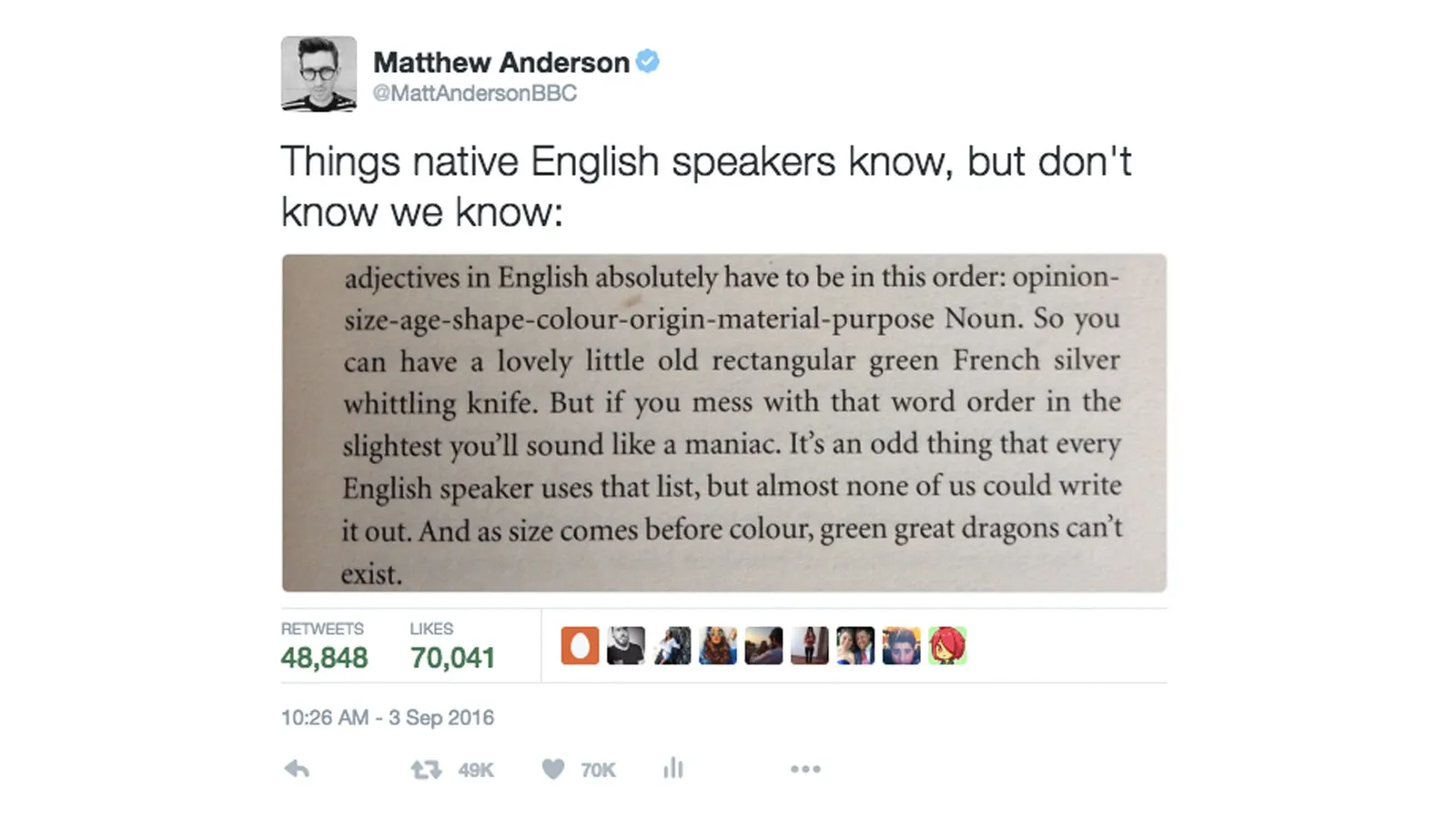
 Adjectives in English absolutely have to be in this order: opinion-size-age-shape-colour-origin-material-purpose Noun. So you can have a lovely little old rectangular green French silver whittling knife. But if you mess with that word order in the slightest you’ll sound like a maniac. It’s an odd thing that every English speaker uses that list, but almost none of us could write it out.”

Actually, there are a couple of small exceptions. Little Red Riding Hood may be perfectly ordered, but the Big Bad Wolf seems to be breaking all the laws of linguistics. Why does Bad Big Wolf sound so very, very wrong? What happened to the rules?

Well, in fact, the Big Bad Wolf is just obeying another great linguistic law that every native English speaker knows, but doesn’t know that they know. And it’s the same reason that you’ve never listened to hop-hip music.

You are utterly familiar with the rule of ablaut reduplication. You’ve been using it all your life. It’s just that you’ve never heard of it. But if somebody said the words zag-zig, or ‘cross-criss you would know, deep down in your loins, that they were breaking a sacred rule of language. You just wouldn’t know which one.


All four of a horse’s feet make exactly the same sound. But we always, always say clip-clop, never clop-clip. Every second your watch (or the grandfather clock in the hall makes the same sound) but we say tick-tock, never tock-tick. You will never eat a Kat Kit bar. The bells in Frère Jaques will forever chime ‘ding dang dong’.


Reduplication in linguistics is when you repeat a word, sometimes with an altered consonant (lovey-dovey, fuddy-duddy, nitty-gritty), and sometimes with an altered vowel: bish-bash-bosh, ding-dang-dong. If there are three words then the order has to go I, A, O. If there are two words then the first is I and the second is either A or O. Mish-mash, chit-chat, dilly-dally, shilly-shally, tip top, hip-hop, flip-flop, tic tac, sing song, ding dong, King Kong, ping pong.


The language rules we know – but don’t know we know
Share on Linkedin
(Credit: Matthew Anderson)
Mark Forsyth tasted internet fame this week when a passage from a book he wrote went viral. He explains more language secrets that native speakers know without knowing.

Article continues below

O

Over the weekend, I happened to go viral. Or rather a single paragraph from a book I wrote called The Elements of Eloquence went viral. The guilty paragraph went like this:

“Adjectives in English absolutely have to be in this order: opinion-size-age-shape-colour-origin-material-purpose Noun. So you can have a lovely little old rectangular green French silver whittling knife. But if you mess with that word order in the slightest you’ll sound like a maniac. It’s an odd thing that every English speaker uses that list, but almost none of us could write it out.”

BBC Culture’s editor Matthew Anderson tweeted a passage from Mark Forsyth’s The Elements of Eloquence and it went viral (Credit: Matthew Anderson)

BBC Culture’s editor Matthew Anderson tweeted a passage from Mark Forsyth’s The Elements of Eloquence and it went viral (Credit: Matthew Anderson)

English speakers love to learn this sort of thing for two reasons. First, it astonishes us that there are rules that we didn’t know that we knew. That’s rather peculiar, and rather exciting. We’re all quite a lot cleverer than we think we are. And there’s the shock of realising that there’s a reason there may be little green men on Mars, but there certainly aren’t green little men. Second, you can spend the next hour of your life trying to think of exceptions, which is useful as it keeps you from doing something foolish like working.

ADVERTISEMENT

Actually, there are a couple of small exceptions. Little Red Riding Hood may be perfectly ordered, but the Big Bad Wolf seems to be breaking all the laws of linguistics. Why does Bad Big Wolf sound so very, very wrong? What happened to the rules?

Ding dong King Kong

Well, in fact, the Big Bad Wolf is just obeying another great linguistic law that every native English speaker knows, but doesn’t know that they know. And it’s the same reason that you’ve never listened to hop-hip music.

If somebody said ‘zag-zig’ or ‘cross-criss’ you would know they were breaking a rule

You are utterly familiar with the rule of ablaut reduplication. You’ve been using it all your life. It’s just that you’ve never heard of it. But if somebody said the words zag-zig, or ‘cross-criss you would know, deep down in your loins, that they were breaking a sacred rule of language. You just wouldn’t know which one.

All four of a horse’s feet make exactly the same sound. But we always, always say clip-clop, never clop-clip. Every second your watch (or the grandfather clock in the hall makes the same sound) but we say tick-tock, never tock-tick. You will never eat a Kat Kit bar. The bells in Frère Jaques will forever chime ‘ding dang dong’.

Reduplication in linguistics is when you repeat a word, sometimes with an altered consonant (lovey-dovey, fuddy-duddy, nitty-gritty), and sometimes with an altered vowel: bish-bash-bosh, ding-dang-dong. If there are three words then the order has to go I, A, O. If there are two words then the first is I and the second is either A or O. Mish-mash, chit-chat, dilly-dally, shilly-shally, tip top, hip-hop, flip-flop, tic tac, sing song, ding dong, King Kong, ping pong.

“What about the Big Bad Wolf?” tweeted many naysayers. But they obviously didn’t know about the rule of ablaut reduplication (Credit: Alamy)

“What about the Big Bad Wolf?” tweeted many naysayers. But they obviously didn’t know about the rule of ablaut reduplication (Credit: Alamy)

Why this should be is a subject of endless debate among linguists, it might be to do with the movement of your tongue or an ancient language of the Caucasus. It doesn’t matter. It’s the law, and, as with the adjectives, you knew it even if you didn’t know you knew it. And the law is so important that you just can’t have a Bad Big Wolf.

Tense situations

It’s astonishing quite how expert you are at the English language. There are so many tenses you can use without even thinking about it, and almost certainly without being able to name them. It depends how you count them, but there are about 20 that you deploy faultlessly. The pluperfect progressive passive for an extended state of action that happened to you prior to another action in the past is, when you put it like that, rather daunting. But then you’d happily say “I realised I’d been being watched” without breaking sweat or blinking. Think how daunting this is for people learning English. The teacher has to explain to them that the English don’t usually use the present tense for things that are happening in the present. “I brush my teeth” doesn’t mean that you’re doing it right now, it just means that you do it regularly. For things that are actually happening right now you use the present progressive “I’m brushing my teeth”.

And having learnt that you then have to learn that there are certain exceptions, like the verb ‘to think’ used as an auxiliary, as in “I think you’re right”. This is why, incidentally, lots of non-native speakers will use phrases like “I am thinking that you are right”. It sounds faintly comic to us, but we had years and years and years of immersion learning just to get all these subtleties. And English is complex and weird. We actually have a tense called the Future Present. Imagine having to learn that. But for us it’s just “The train leaves tomorrow.”


Some rules we really should know. It’s surprising and dispiriting how many English people don’t know the rules of stress, because that’s how all our poetry works. It’s quite easy really, and we can hear it in other languages. Everyone knows that Italian has rhythm, it goes MAM-a MI-a BUON-a SER-a. But so does our language. And that’s how verse works. I can illustrate with my favourite limerick (or at least my favourite clean one). Try reading this aloud:


There was a young man from Dundee

Got stung on the leg by a wasp

When asked does it hurt

He said ‘Yes it does.

‘I’m so glad it wasn’t a hornet.’


That has no rhymes, but it still works as a limerick because rhymes aren’t nearly as important as rhythm. And the rhythm goes:


de-DUM-de, de-DUM-de, de-DUM

de-DUM-de, de-DUM-de, de-DUM

de-DUM-de, de-DUM

de-DUM-de, de-DUM

de-DUM-de, de-DUM-de, de-DUM-de